Laurence Piper, Gillian Black, Anna Wilson, Liezl Dick and Tsitsi Mpofu-Mketwa
This blog post is based on the Evidence & Policy article, ‘Policy engagement as ‘empowered representation’: democratic mediation through a participatory research project on climate resilience’.
Policy engagement is both a condition and moral obligation of publicly funded research projects in many countries, and our case in South Africa was no different. It was just relatively difficult.
In 2019 we won a UKRI grant to do participatory research on how people living in poor settlements in Cape Town experience and respond to the climate-related hazards of water scarcity, floods and fires. The idea was to work closely with affected community members in understanding how they coped with these disasters, and what they thought could be done better in the future, by themselves and with help from others. We discussed our experiences in our recent article in Evidence and Policy, and summarise some of them here.
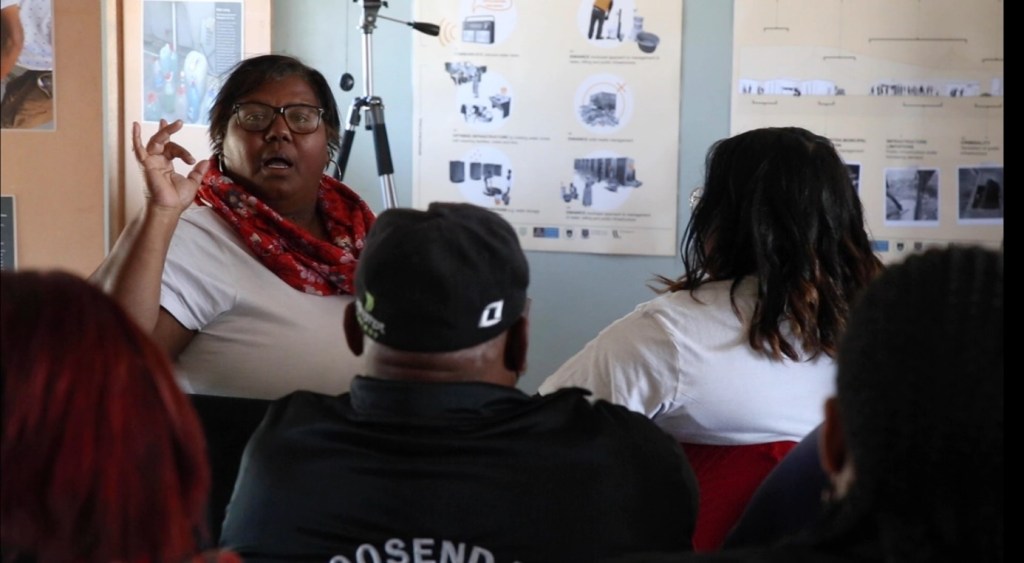
These community participants then presented their experiences and ideas for climate resilience as ‘best bets’ to government officials in a series of deliberative workshops.
But achieving this ‘policy engagement’ was easier said than done. The name of our project was ‘Water and Fire’ and in many ways this is how government officials and marginalized residents perceived each other. Officials see informal settlements as places of ‘fire’: anarchic, unstable and violent, and the community members regard the city as ‘water’: cold, and mostly indifferent, but when engaged on challenging issues that affect the poor, ‘washing away’ informality through force.
Yet we were able to run a vigorous policy engagement process, and for three reasons.
First and foremost, our research project included partners that could mediate both sides of the political relationship in Cape Town. In this respect, a local non-profit, the Sustainable Livelihoods Foundation (SLF) (), was invaluable because it had gained credibility with city officials and had done research and innovation practice in similar settings for many years. SLF had the trust of both sides to set up a process whereby city officials and community representatives could meet several times – an ‘invented space’ that otherwise would not exist.
Second, SLF worked hard to make sure that this process of engagement was a democratic one. The resilience literature shows that engagement often results in government imposing ‘global best practices’ on marginalised communities, despite the better judgement of residents. To avoid this, SLF worked with local community members to unpack their insights and ideas on building climate resilience through using a variety of visual methods like digital storytelling, community mapping and photovoice. Then, SLF supported community members in fine-tuning their presentations through peer learning and expert feedback so that they could assuredly represent themselves when meeting city spokespersons. In brief, SLF did not speak for these community members but supported them to speak for themselves.
Third, a key part of this empowerment process was facilitating community members to engage in making evidence-based arguments rather than only making demands – the default practice of protest politics in South Africa. Importantly, these arguments were rooted in the participatory methods listed above. The visual methodology helped the participating residents to locate their ideas and suggestions in their stories and lived experiences. The central concept was to communicate at a human level rather than through appeals to legal rights or abstract moral principles.
As one community member said: ‘I learned that there’s methods, photovoice, drawing, and handing it to the right people…has the same impact as the olden way but it’s less violent and when we are doing it, it’s fun like everybody is laughing but at the end the message that we want to get out there its strong and powerful.’ In addition to empowering community participants to find creative ways of representing their ideas, the impact on officials was compelling. As one official said, ‘Listening to the whole video with the women’s experience that they presented through pictures… is enlightening’.
A key insight of the study is the value of designing climate resilience policy processes for the political context of the work, including creating such engagement opportunities where they do not exist and supporting poor and marginalized groups, where necessary, to speak for themselves. Finally, participatory visual methods and story-telling methods can be a powerful way of connecting the experiences of the marginalized to policy frameworks informed by rights and principles.
Image credit: Water & Fire research project

Laurence Piper
Professor, University West, Sweden
Laurence.Piper@hv.se; linkedin.com/in/laurence-piper-08ab6712/

Gillian Black, PhD
Managing Director, Sustainable Livelihoods Foundation (SLF)
gill.black@livelihoods.org.za; https://www.linkedin.com/in/gill-black-b1606233/

Anna Wilson, PhD
Reader in Interdisciplinary Research in Education (School of Education), University of Glasgow
Anna.Wilson.2@glasgow.ac.uk; linkedin.com/in/anna-wilson-a9136648/

Liezl Dick, PhD
ResEd Curriculum Coordinator at Stellenbosch University
linkedin.com/in/liezl-dick

Tsitsi Mpofu-Mketwa, PhD
Assistant Professor, Carleton University
tsitsimpofumketwa@cunet.carleton.ca; linkedin.com/in/tsitsi-mpofu-mketwa-phd-5525b533/
Read the original research in Evidence & Policy:
Piper, L. Black, G.F. Petersen, L. Dick, L. Wilson, A & Mpofu-Mketwa, T. (2024). Policy engagement as ‘empowered representation’: democratic mediation through a participatory research project on climate resilience. Evidence & Policy, DOI: 10.1332/17442648Y2024D000000033.
If you enjoyed this blog post, you may also be interested in reading:
How did UK policymaking in the COVID-19 response use science? Evidence from scientific advisers
Disclaimer: The views and opinions expressed on this blog site are solely those of the original blog post authors and other contributors. These views and opinions do not necessarily represent those of the Policy Press and/or any/all contributors to this site.
 Evidence & Policy Blog