K. L. Akerlof, Todd Schenk, Adriana Bankston, Jessica L. Rosenberg, Anne-Lise K. Velez, Lisa Eddy and Nikita Lad
This blog post is based on the Evidence & Policy article, ‘Training researchers to engage in policy in the United States: mapping the growth and diversity of programme models’.
In recent years, state-level programmes that support the engagement of scientists in public policy have been growing across the United States. These initiatives offer training, networking and government placements to help bridge the gap between research and policymaking. However, little data exist on the structure, goals and impacts of these programmes. A recent study describes this evolving national landscape, using programmes in Virginia as a case study.
The rise of science policy training
A growing number of programmes seek to prepare researchers for active roles in policy. These initiatives include:
- Academic programmes offering courses, certificates, degrees and workshops in science policy.
- Student organisations that provide training and networking opportunities.
- Government placements and fellowships that immerse researchers in legislative and executive roles.
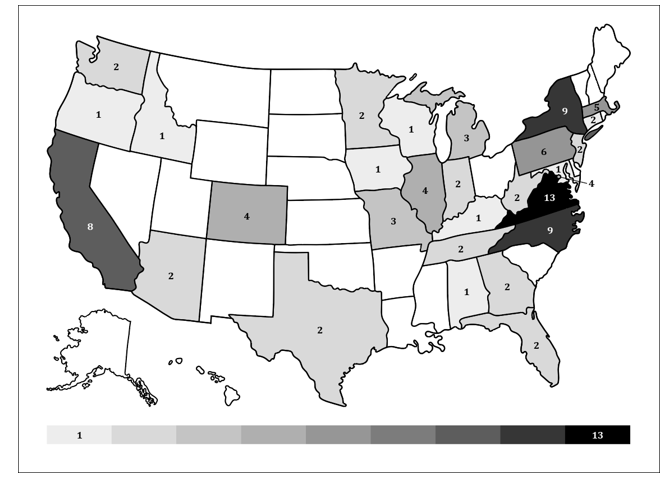
This study identified 174 science policy programmes across the United States, with more than half (57%) operating at the state level (Figure 1). Virginia, with its diverse and numerous programmes, stands out as a leader in policy training opportunities.
Key findings from Virginia’s science policy programmes
The researchers found commonalities in the goals, audiences and challenges of the 12 Virginia-based science policy programmes:
- Programmes aim to integrate scientists into policy processes by developing their skills to work with decision-makers and communicate research findings effectively.
- Graduate students are the most common audience. Undergraduate students and postgraduate researchers are also frequently the focus for these programmes.
- Despite their diverse formats, these programmes have similar long-term goals, such as increasing the presence of scientists in policymaking.
- Challenges remain in assessing programme impact, as many lack time and formal evaluation methods to track long-term effectiveness.
The role of scientists in policymaking
The engagement of scientists in policy processes can take varying forms, from translating cutting-edge research for decision-makers to policy advocacy. This study found that the majority of science policy programmes in Virginia emphasise integrating scientific results into policy decisions by working closely with policymakers (Figure 2). This result reflects a broader trend in which scientists act as knowledge brokers, helping decision-makers apply scientific evidence to governance.
Despite common goals, there is no one-size-fits-all approach. Some programmes train researchers to interpret and report scientific findings without making policy recommendations, while others encourage advocacy for specific policies. This variation suggests that science policy training is evolving to accommodate different perspectives on the role of scientists in governance.

How research is used in policy
Just as scientists engage in policy in different ways, decision-makers also use scientific evidence in varied forms. This study found that science policy programmes in Virginia most strongly emphasise instrumental and conceptual uses of research (Figure 3):
- Instrumental use: When scientific evidence directly informs a policy decision.
- Conceptual use: When scientific evidence helps policymakers develop a deeper understanding of an issue.
In contrast, strategic or symbolic uses of research – where scientific evidence is selectively used to justify pre-existing policy positions – were not a primary focus of these programmes. This suggests that science policy training efforts prioritise knowledge transfer and have yet to explore fully the use of science for strategic influence.

Strengthening the science-policy ecosystem
This study highlights the need for science policy programmes to employ:
- Shared learning and collaboration: Establishing networks between programmes to share best practices.
- Programme evaluation tools: Developing better ways to measure long-term impacts.
- Expanded access to training: Increasing opportunities for researchers at all career stages, particularly at less research-intensive universities.
Science policy programmes are rapidly expanding nationwide, but their sustainability depends on continued investment, collaboration and adaptability to changing policy landscapes. By building stronger networks and refining approaches, these initiatives can ensure that scientists are well-prepared to influence public policy for years to come.
Image credit: Image created with the assistance of DALL·E 3.
K. L. Akerlof is an associate professor in the Department of Environmental Science & Policy, George Mason University, United States. Her research focuses on the intersection of governance with science and risk communication. Visit her institutional profile here.
Todd Schenk is an associate professor and the chair of the Urban & Environmental Policy & Planning programme in Virginia Tech’s School of Public and International Affairs, and the founding director of the Science, Technology & Engineering in Policy (STEP) programme. His research focuses on the intersection of environmental policy & planning issues and collaborative governance. View his institutional profile here.
Adriana Bankston is an advocate for scientific research and innovation at the federal level. As the first-ever AAAS/ASGCT Congressional Policy Fellow, she currently works to support sustained federal research funding in the US House of Representatives. Visit her website here.
Jessica L. Rosenberg is an associate professor of Physics and Astronomy and Director of Education for the Quantum Science and Engineering Center, George Mason University. Her research focuses on improving STEM education and workforce development. Visit her institutional profile here.
Anne-Lise K. Velez is a collegiate associate professor in the Honors College at Virginia Tech, where she is also affiliated with the School of Public and International Affairs. Her research focuses primarily on public and nonprofit management and transdisciplinary scholarship of teaching and learning. Visit her institutional profile here.
Lisa Eddy is the Research and Education Coordinator for Virginia Sea Grant and currently manages the Commonwealth Marine and Coastal Policy Fellowship. More about Lisa and Virginia Sea Grant’s efforts in the science/policy interface here.
Nikita Lad is a doctoral alumna of George Mason University, the founder of the Science Policy Network, and a current Colorado state government employee. Her research focuses on sustainable governance and behavior. Learn more about her and connect on LinkedIn here.
Read the original research in Evidence & Policy:
Akerlof, K.L. Schenk, T. Bankston, A. Mitchell, K. Syl, A. Eddy, L. Hall, S.L. Lad, N. Lake, S.J. Ostrom, R.B.J. Rosenberg, J.L. Schwartz, M.R. Sisti, A.R. Smith, C.T. Solomon, L. & Velez, A.L.K. (2025). Training researchers to engage in policy in the United States: mapping the growth and diversity of programme models. Evidence & Policy, DOI: 10.1332/17442648Y2025D000000046. OPEN ACCESS
If you enjoyed this blog post, you may also be interested in reading:
Disclaimer: The views and opinions expressed on this blog site are solely those of the original blog post authors and other contributors. These views and opinions do not necessarily represent those of the Policy Press and/or any/all contributors to this site.
 Evidence & Policy Blog