How to lead an evidence centre


Steve Martin

This blog post is based on the Evidence & Policy article, ‘Leading research–policy engagement: an empirical analysis of the capabilities and characteristics of leaders of evidence intermediary organisations’.

In the last ten years, a range of countries have invested in organisations designed to bridge the gap between researchers and policymakers. In the United Kingdom alone, we now have 12 What Works Centres, 30 Health Determinants Research Collaborations, three Local Policy Innovations Partnerships, several regional evidence centres, and dozens of policy engagement teams working in universities, businesses and charities.

The leadership of these evidence intermediaries is key to their effectiveness. But we know very little about their leaders – where they come, what they do, and what skills they need for the job. To help fill this gap, I conducted in-depth interviews with leaders of some of the UK’s most high-profile evidence intermediary organisations. Their stories provide fascinating ‘warts and all’ accounts of what it takes to lead an organisation that can overcome the formidable institutional barriers that often stand in the way of evidence-informed policy and practice.

Continue reading

Evidence & Policy Call for Abstracts: Special Issue: Strengthening Research Practice Partnerships in Social Care: Evidence, Impact and Policy Learning

Special Issue Editors: Professor Annette Boaz and Professor Ann-Marie Towers

Abstract Submission Deadline: Monday 3 November 2025

Background to the Special Issue

Research practice partnerships (RPPs) offer transformative potential by embedding rigorous evidence into decision making and practice, yet there is limited synthesis of how such collaborations function and their influence on policy and practice.  Research practice partnerships have featured in previous editions of Evidence & Policy (for example, Hoekstra et al 2021; Gray et al 2024) and the importance of collaborative working and relationships is a core theme in journal submissions, including in a key paper by Best and Holmes (2010).

This Evidence & Policy special issue builds on empirical and conceptual learning from six RPPs in England funded by the National Institute for Health and Care Research.  It will also feature contributions from a wider group of partnerships emerging from the social care/ human services sectors internationally—to generate comparative insights on structures, mechanisms for co production, knowledge mobilisation strategies, and policy impact. 

Aims of the special issue:

  1. Evaluate the impact of RPP typologies in social care/ human services.
  2. Examine co-production and governance models that facilitate practitioner and public engagement.
  3. Evaluate how generated evidence contributes to organisational policy decisions and builds research capacity
  4. Identify transferable lessons for establishing and sustaining collaborative RPPs.

Invitation to Submit Proposals

Interested authors should send a 300-word abstract to Special Issue Editors Professor Annette Boaz (Annette.boaz@kcl.ac.uk) and Professor Ann-Marie Towers (ann-marie.towers@kcl.ac.uk) by Monday 3 November 2025.

Invitations for full paper submissions will be sent in mid-November, and full papers will be due by end of March 2026.

We welcome submissions on:

  • Research Articles employing mixed methods evaluations of RPP outcomes.
  • Perspectives discussing methodological and ethical challenges in partnership design.
  • Theory & Methods papers on frameworks for assessing embedded evidence impact.

Against unanimity: the perils of negotiating collective policy recommendations across a diverse third sector


Jane Cullingworth

This blog post is based on the Evidence & Policy article, Strengthening the role of third sector intermediary bodies in democratic governance: developing strategies with state and non-state actors’.

We can all agree that evidence needs to shape policy but how do we gather evidence, particularly from the frontlines? With the rise of participatory governance and an interest in the perspectives of communities, the third sector is uniquely placed to play a key role in facilitating and generating this evidence. But given the diversity of third sector stakeholders and multitude of perspectives, how is such evidence understood, interpreted and represented?

Animating knowledge requires intermediaries (known as knowledge brokers) to translate lived experience into action, addressing the know-do gap – that is, a gap between knowledge and policy. Across the third sector there are many intermediary bodies – organisations that support the sector and represent its interests. While these organisations are not typically thought of as knowledge brokers in the policy arena, they play an important role in ensuring that the voices of citizens and civil society groups are included in policy. Many are highly active in networks and partnerships with state actors.

Continue reading

Optimising microsurveys to improve the use of research evidence from websites


Esmeralda Michel, Megan Mitchell, Nehal Eldeeb and Valerie B. Shapiro

This blog post is based on the Evidence & Policy article, Promoting the use of research evidence from websites: optimising microsurveys as feedback loops to drive improvement’.

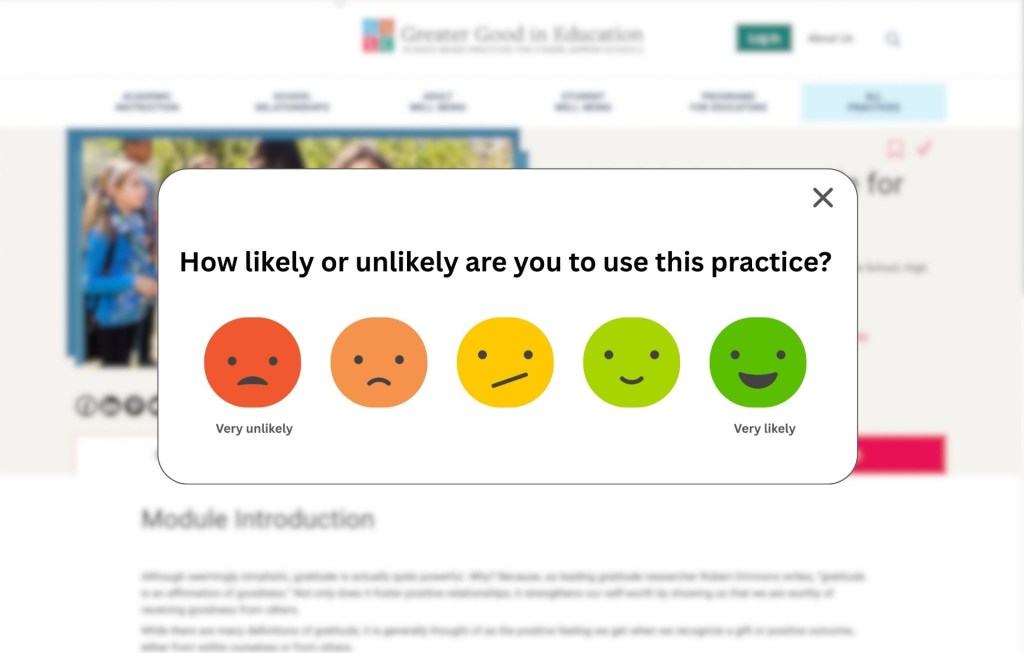
There are many efforts to make research evidence accessible to educators online through toolkits and in other user-friendly formats. Intermediaries – which are organisations that sit between research and practice – can take on the mission of synthesising, translating and sharing research for the public. One such intermediary is the Greater Good in Education (GGIE), an organization that hosts a website of evidence-based practices for educators. Yet a persistent challenge remains among these types of intermediaries: once research evidence is packaged and posted, how do we know the extent to which the evidence is being accessed, appraised and applied in practice? Intermediaries are missing ‘feedback loops’ that could help the intermediaries adapt and improve their efforts to promote the use of research evidence.

In a recent study published in Evidence & Policy, researchers Eldeeb, Ren, and Shapiro explored whether microsurveys could help fill this gap. Microsurveys are short surveys embedded directly on a webpage, triggered by specified interactions with the website. They can capture real-time feedback from users, providing actionable insights into whether research evidence is likely to be applied in practice.

Continue reading