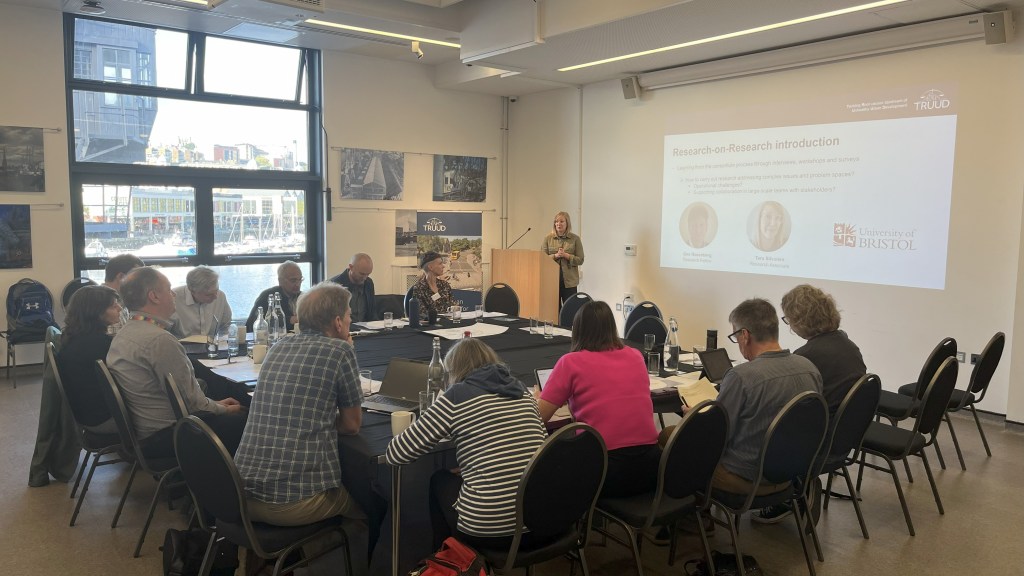
Taru Silvonen and Ges Rosenberg
This blog post is based on the Evidence & Policy article, ‘Optimising teamworking processes in an ongoing research consortium: a qualitative study’.
Considering collaboration is needed to solve complex societal problems, why are the structures that can help teams work together so often overlooked in research settings?
Complex research projects often require large teams with a wide range of expertise to work together. Working across disciplines and professional boundaries can be exciting but also comes with its own challenges, as shown by research in team science. These challenges are particularly present in transdisciplinary partnerships that aim to tackle evolving societal challenges, which makes our work relevant beyond academic teams. While interdisciplinary teams combine knowledge from different fields, transdisciplinary teams aim to create real-world change by involving both academic and non-academic partners. This provides opportunities for peer learning as well as bridging thinking between different perspectives. However, an appreciation of different ways of working, thinking, and communicating within a team will be required.
Our Evidence & Policy article shares insights from a UK-based research consortium called TRUUD (Tackling Root Causes Upstream of Unhealthy Urban Development), which focuses on creating healthier urban environments to reduce non-communicable diseases (NCDs) in the UK. TRUUD consists of 40+ academics in a transdisciplinary consortium, meaning it does not just combine academic disciplines – it also includes practitioners and stakeholders working together to solve real problems. Our qualitative study explores what helps large, complex teams work well together, especially in transdisciplinary (TD) settings, and how to overcome common challenges (i.e. building shared understanding and navigating conflict).
To understand how TRUUD functions, we carried out 20 interviews (2023–2024) and a workshop in 2024 with TRUUD members. We analysed the qualitative data using a process-based approach, which helped us break down the complex dynamics of the project into smaller, more manageable parts. The interviews focused on participants’ views on the project’s mission, collaboration, networking, and how knowledge was shared.
What makes a team effective?
Previous research shows that three types of processes are present in effective teams in different settings:
- Cognitive processes that relate to thinking and sharing knowledge as well as psychological safety.
- Motivational and affective processes such as being committed and feeling connected within the team.
- Behavioural processes or how team members interact with one another and make collective decisions.
TRUUD showed strong motivational and relationship-building processes: team members were committed to the aims of the research and able to form connections with one another. However, cognitive processes such as developing shared mental models (common understandings of how the team works and what each member knows and expects) were more challenging. The challenges in building shared understanding and ways of working had a negative effect on collaborative practices such as forming consensus and seeking support for ideas, developing further collaboration as well as reflecting on practices in a holistic manner. As such, these challenges hindered further collective innovation and limited the team’s capacity to deliver more advanced impactful research.
We found that without clear structures to support cognitive processes, teams can struggle to navigate collaborative practices during earlier stages when collective shaping and defining of the complex problem space is needed. This misalignment can lead to unresolved issues that slow down progress, especially in the later stages of a project.
Having shared goals that motivate the team is important but may not be enough to help teams navigate the challenges of large-scale projects without a solid shared understanding of what the project is about and how to work together towards shared aims: teams also need shared mental models to work effectively. Our findings show that it is crucial to invest time early on to build shared practices and support systems. Teams need to understand what they’re doing but also how they can do it together.
We recommend that large research teams use practical frameworks to guide their work and actively support cognitive processes (see article for further details of toolkits such as SHAPE-ID https://www.shapeidtoolkit.eu/). Building infrastructure to help teams develop shared understanding and make decisions together is key to successful transdisciplinary research as this helps teams stay aligned and work more effectively throughout a project.
Our Evidence & Policy article forms part of a broader longitudinal study. While this work looks at one snapshot of a 6-year research programme, our upcoming work also looks at the programme as a whole.
Image credit: Author’s own (provided by TRUUD).
Taru Silvonen is a Research Associate at the school of Electrical, Electronic and Mechanical Engineering at the University of Bristol. She also works as a Senior Research Associate at the Centre of Public Health, University of Bristol.
Ges Rosenberg is Co-Lead of City Futures at the Cabot Institute and a Research Fellow in Engineering Systems and Design at the University of Bristol. His expertise lies in the intersection of engineering, design and urban planning, with a focus on sustainable and resilient cities.
Read the original research in Evidence & Policy:
Silvonen, T. & Rosenberg, G. (2025). Optimising teamworking processes in an ongoing research consortium: a qualitative study. Evidence & Policy. DOI: 10.1332/17442648Y2025D000000065. OPEN ACCESS
If you enjoyed this blog post, you may also be interested in reading:
Understanding the dynamics of research–policy fellowships: an evaluative analysis of barriers and blockages OPEN ACCESS
The influence of public policy and administration expertise on policy: an empirical study
Disclaimer: The views and opinions expressed on this blog site are solely those of the original blog post authors and other contributors. These views and opinions do not necessarily represent those of the Policy Press and/or any/all contributors to this site.
 Evidence & Policy Blog