The editorial team of Evidence & Policy is pleased to see the publication of our fourth and final issue for 2025, Evidence & Policy Volume 21: Issue 4. This issue has a lot of work focused on how political elites use and are impacted by evidence in the policymaking process. A major thread through this work is that while evidence has an impact, there are important limitations.
The first piece examines programs designed to support scientists and engineers in engaging in public policy, specifically studying the state of Virginia. Through surveys and interviews of program leaders, the study finds evidence of perceived impact, though limits in the ability to implement evidence-based approaches.
The second article also finds impact and its limitation, but this time using policy documents. They find that policy think tanks draw from academic expertise more readily than governments.
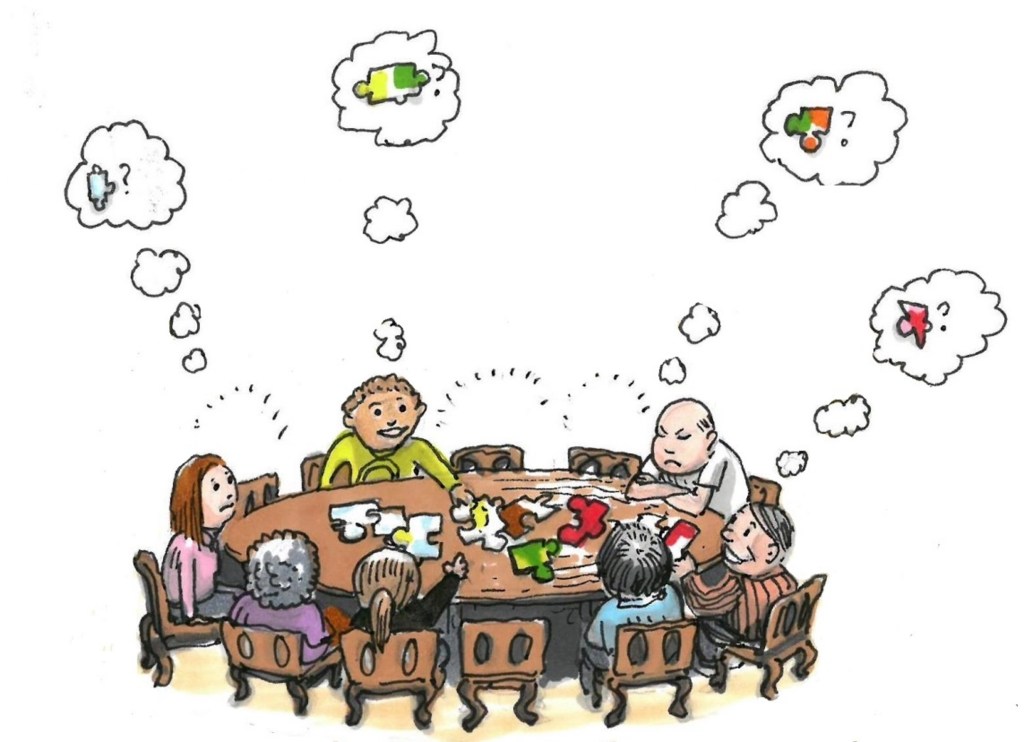
Integrated care is commonly seen as the means to bridge gaps between organisations, services and professions across the health and care landscape and improve care. The promise is compelling: bring health and social care practitioners together, and they’ll share their expertise to create holistic, joined-up care for people with complex needs. Simple, right?
Not quite. After spending over two years observing case management meetings across five integrated teams, I found that knowledge sharing was far messier than the policy rhetoric suggests. My research drew on organisational knowledge creation theory to reveal four patterns that help explain why this is the case.
Special Issue Editors: Professor Annette Boaz and Professor Ann-Marie Towers
Abstract Submission Deadline: Monday 3 November 2025
Background to the Special Issue
Research practice partnerships (RPPs) offer transformative potential by embedding rigorous evidence into decision making and practice, yet there is limited synthesis of how such collaborations function and their influence on policy and practice. Research practice partnerships have featured in previous editions of Evidence & Policy (for example, Hoekstra et al 2021; Gray et al 2024) and the importance of collaborative working and relationships is a core theme in journal submissions, including in a key paper by Best and Holmes (2010).
This Evidence & Policy special issue builds on empirical and conceptual learning from six RPPs in England funded by the National Institute for Health and Care Research. It will also feature contributions from a wider group of partnerships emerging from the social care/ human services sectors internationally—to generate comparative insights on structures, mechanisms for co production, knowledge mobilisation strategies, and policy impact.
Aims of the special issue:
Evaluate the impact of RPP typologies in social care/ human services.
Examine co-production and governance models that facilitate practitioner and public engagement.
Evaluate how generated evidence contributes to organisational policy decisions and builds research capacity
Identify transferable lessons for establishing and sustaining collaborative RPPs.
Invitation to Submit Proposals
Interested authors should send a 300-word abstract to Special Issue Editors Professor Annette Boaz (Annette.boaz@kcl.ac.uk) and Professor Ann-Marie Towers (ann-marie.towers@kcl.ac.uk) by Monday 3 November 2025.
Invitations for full paper submissions will be sent in mid-November, and full papers will be due by end of March 2026.
We welcome submissions on:
Research Articles employing mixed methods evaluations of RPP outcomes.
Perspectives discussing methodological and ethical challenges in partnership design.
Theory & Methods papers on frameworks for assessing embedded evidence impact.
The editorial team of Evidence & Policy are excited to share this special collection of articles focused on the intersections between health, evidence use, and the application of research within evolving and complex public health policy contexts.
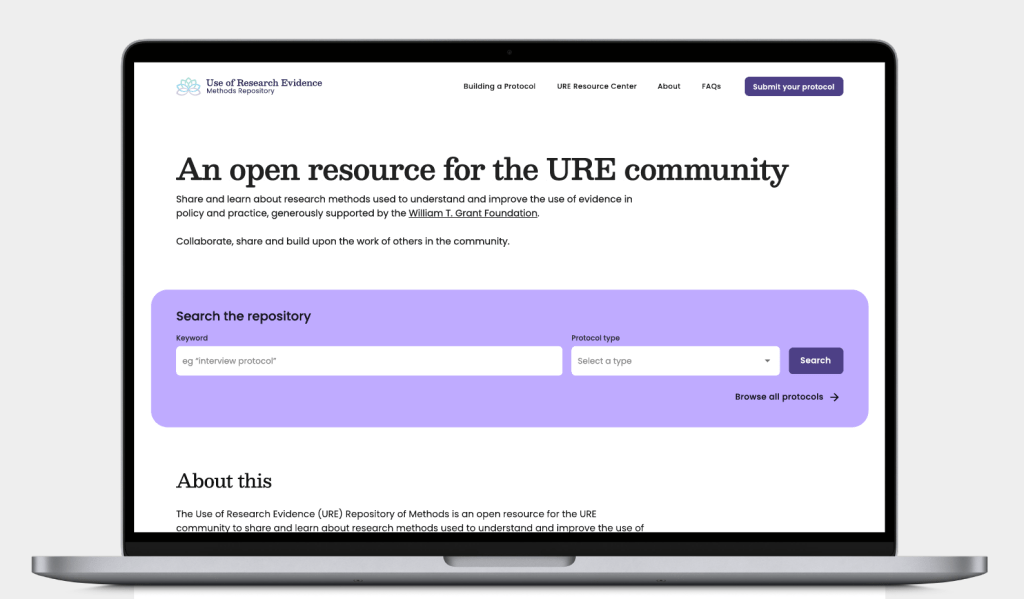
There are two critical problems facing the use of research evidence (or URE) space. The first is the limited opportunity to learn about how other disciplines are researching URE. The second is the lack of open and interdisciplinary debate about what counts as good quality research in the field. The URE Methods Repository seeks to address these problems. By providing improved access to published papers, data, analysis tools, and preprints, the repository aims to promote more connected, innovative practice and help us to avoid reinventing the wheel.
Almost two decades ago Carol H. Weiss and co-authors described the idea of evidence-based policies as a ’fairy godmother’ with ’some warts’. In other words, although evidence-based policies clearly entailed some challenges and drawbacks, like discounting local professional judgement, it was still worth pursuing to ’increase the rationality of decision-making’, as they put it.
Yet, studies of evidence-based policy making in action in the past decades have shown that although the aspiration to use evidence to enhance the legitimacy and effectiveness of policies is still widely shared, it often falls short. A common explanation for failure is the presence of various barriers. In our Evidence & Policy article, we critically revisit Weiss and her co-authors’ argument to question whether the challenges related to evidence-based policy making are in fact simply ’warts’ that can be removed, or are more fundamental challenges associated with the aims and management of evidence-based policy making in different policy areas.
To what extent is academic expertise used in governance processes around the world? Do actors in the policy and public sector draw on research to improve their decision making? Are public administration researchers providing the public policy sector with relevant expertise for their decision making? These core questions led us to analyse the uptake of public policy and administration (PPA) research in policy documents.
Our study is based on the Overton database because it currently has the largest coverage of policy documents (broadly defined). The database makes available the meta data (e.g., title, URL, issuing organisation) of the policy documents and their cited references. Thus, we were able to connect the policy documents with the PPA research they cited using the Web of Science (WoS, Clarivate), an established resource with quality control for indexed journals. These direct citation relations provide insights into the knowledge flows from research to policymaking. We looked at 41 WoS-indexed journals that are classified under the category “Public Administration” by Clarivates’ Journal Citation Reports.
The Editorial Management Board of the journal Evidence & Policy invites applications for Associate Editors. Evidence & Policy is the first peer-reviewed journal dedicated to comprehensive and critical assessment of the relationship between research evidence and the concerns of policy makers and practitioners, as well as researchers.
We are pleased to introduce the new Editors in Chief of Evidence & Policy: Dr Mariah Kornbluh, University of Oregon, and Dr Dan Mallinson, Penn State Harrisburg.
When it comes to furthering the reach of scientific evidence in policymaking processes, a large body of research has shown just how crucial personal relationships between researchers and policymakers can be. These personal relationships can help offset the overloading workload of policymakers and their staffers, especially considering they often rely on trusted sources for advice and information. However, there are often group norms, systemic differences, and other obstacles standing in the way of relationships between policymakers and researchers initially forming.






 Evidence & Policy Blog