Scaling-up user-engagement in education research: drawing insights from Canada’s experience


Bernadine Sengalrayan and Blane Harvey

This blog post is based on the Evidence & Policy article, ‘Engaging knowledge users in Canadian knowledge mobilisation research: a scoping review of research in education.

In the ever-evolving landscape of education policy and practice, research has a critical role to play in informing planning and action. However, in many countries, the link between education research conducted by academics and the potential users of that research in schools and other educational settings is not robust. Knowledge mobilisation (KMb) approaches are seen as an important way to bridge the gap between research production and its practical application in any number of settings, including education.

To better understand if KMB practices are helping to inform educational policy and practice, we explored the changing dynamics of research producer-user connections in Canadian K-12 teaching and education policy. Here are some of the highlights from our findings.

Continue reading

The role of intermediaries in evidence-based policymaking: insights from the education system in Israel


Barak Ariel and Hagit Sabo-Brants

This blog post is based on the Evidence & Policy article, ‘Building bridges in place of barriers between school practitioners and researchers: on the role of embedded intermediaries in promoting evidence-based policy’.

The Israeli education system provides insights into the importance of intermediaries in evidence-based policymaking. Effective intermediaries can bridge the gap between research and practice by fostering collaboration and facilitating knowledge transfer between researchers, policymakers, and practitioners. The ideal intermediary should have the respect of both researchers and practitioners and a comprehensive understanding of both worlds. Practitioners should be involved in selecting and implementing intermediaries to meet their needs. Applying intermediaries in policymaking can result in more efficient and effective policies that benefit researchers and practitioners.

Continue reading

In the age of evidence-based decision-making, where can education decision makers really turn for evidence?

Fiona Hollands and Venita Holmes

This blog post is based on the Evidence & Policy article, Comparing evidence on the effectiveness of reading resources from expert ratings, practitioner judgements, and research repositories’.

In 20172018, a large school district in the U.S. was threatened by the state education agency with closure of 23 struggling elementary schools unless it could improve students’ performance on state-mandated assessments. The district’s Office of Elementary Curriculum and Development immediately tried to determine which reading resources (reading programmes, assessments, online tools, book collections, and professional development supports) were available at each school and to assess their effectiveness at improving student reading proficiency. To help with this evaluation task, our research-practice team explored various options for quickly providing suitable evidence on the effectiveness of each of 23 reading resources used at one or more of these schools. We expected to find reasonable consistency across multiple sources of information that we could use to help guide the district’s actions. The results were not quite as expected.

Continue reading

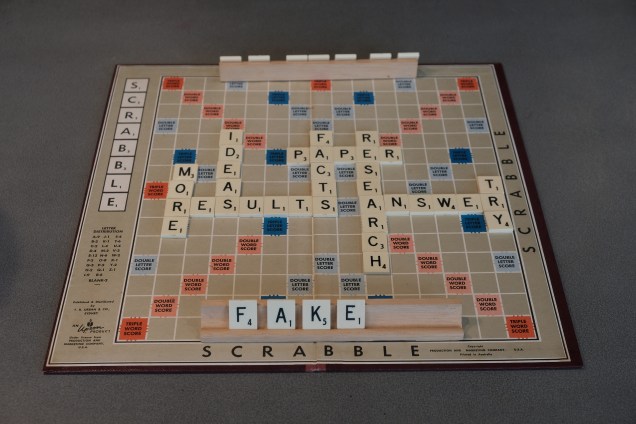
Thought experiments with ‘fake’ research abstracts help policy makers visualise actions to be taken on evidence

Scrabble

Penelope Hawe

Our university-policy maker partnership produces ‘fake’ abstracts of articles we’ve not written yet (on results we frankly don’t even know we’ve got) to loosen up thinking. It helps the team visualise pathways for policy action.

Ours is a tricky situation, politically-speaking. A health department is undertaking Australia’s largest ever scale-up of evidence-based childhood obesity programs into every school and childcare centre across the state.[1] It costs $45m. They have an electronic data monitoring system in place. It’s already telling them that targets are being met. But rather than just rest on their success, they invite a team of researchers to do a behind-the-scenes, no-holds-barred ethnography. It could reveal the ‘real’ story of what’s goes on at the ground level.[2]

Continue reading

How educators and policy makers think differently about research

Jennifer Lawlor, Kathryn McAlindon, Kristen Mills, Jennifer Neal and Zachary Neal

Policy makers are working hard to promote the use of research in education. But, does ‘research’ mean the same thing to policy makers and educators? While this question might seem basic, it’s important to know if policy makers and educators are speaking the same language.

In this blog, we discuss the findings of our recent research article, ‘What is research? Educators’ conceptions and alignment with United States federal policies‘, published in Evidence & Policy, which has been awarded the 2019 Carol Weiss Prize.

It examines similarities and differences between educators’ definitions of research and the definitions used in US Federal education policy. Our findings show that educators tend to focus on the process and products of research, while policy definitions focus on data and outcomes.

Continue reading

Decision-makers should listen to youth and new research shows how this can work

This blog post is the third in a series of posts linked to the Evidence & Policy special issue (Volume 16, Issue 2) on Opening up evidence-based policy: exploring citizen and service user expertise. Guest Edited by Ellen Stewart, Jennifer Smith-Merry, and Marc Geddes.

Scott Warren

I am the co-founder and chief executive officer of Generation Citizen, a non-governmental organization in the United States of America that seeks to empower young people to become engaged and effective citizens, and the author of the 2019 book Generation Citizen: The Power of Youth in Our Politics. At Generation Citizen, we are deeply committed to closing the civic engagement gap.  We offer school-based action civics programming, which provides young people with the opportunity to learn how to affect policy change and work together to take action on a local community issue.  Thousands of Generation Citizen classes have completed these action projects since our founding over a decade ago, and so I have witnessed firsthand the importance and influence of citizen and service user knowledge– in this case, youth knowledge– in informing policy and school decision-making. When students work together to generate relevant evidence and offer evidence-informed ideas of possible solutions, decision-makers should listen.  Sometimes students’ lived experiences can uncover outdated regulations that need updating, or work to better support their most marginalized classmates and their families. Yet, too few decision-makers are listening to youth, especially youth from marginalized backgrounds, and we must do more to facilitate incorporating lived experiences into policy. This is one of the reasons why Generation Citizen has worked to support efforts around the USA to lower the voting age to 16, to create an additional incentive for political leaders to listen to youth.  

Continue reading