New Evidence & Policy issue – Volume 21: Issue 4

The editorial team of Evidence & Policy is pleased to see the publication of our fourth and final issue for 2025, Evidence & Policy Volume 21: Issue 4. This issue has a lot of work focused on how political elites use and are impacted by evidence in the policymaking process. A major thread through this work is that while evidence has an impact, there are important limitations.

The first piece examines programs designed to support scientists and engineers in engaging in public policy, specifically studying the state of Virginia. Through surveys and interviews of program leaders, the study finds evidence of perceived impact, though limits in the ability to implement evidence-based approaches.

The second article also finds impact and its limitation, but this time using policy documents. They find that policy think tanks draw from academic expertise more readily than governments.

Continue reading

Optimising microsurveys to improve the use of research evidence from websites


Esmeralda Michel, Megan Mitchell, Nehal Eldeeb and Valerie B. Shapiro

This blog post is based on the Evidence & Policy article, Promoting the use of research evidence from websites: optimising microsurveys as feedback loops to drive improvement’.

There are many efforts to make research evidence accessible to educators online through toolkits and in other user-friendly formats. Intermediaries – which are organisations that sit between research and practice – can take on the mission of synthesising, translating and sharing research for the public. One such intermediary is the Greater Good in Education (GGIE), an organization that hosts a website of evidence-based practices for educators. Yet a persistent challenge remains among these types of intermediaries: once research evidence is packaged and posted, how do we know the extent to which the evidence is being accessed, appraised and applied in practice? Intermediaries are missing ‘feedback loops’ that could help the intermediaries adapt and improve their efforts to promote the use of research evidence.

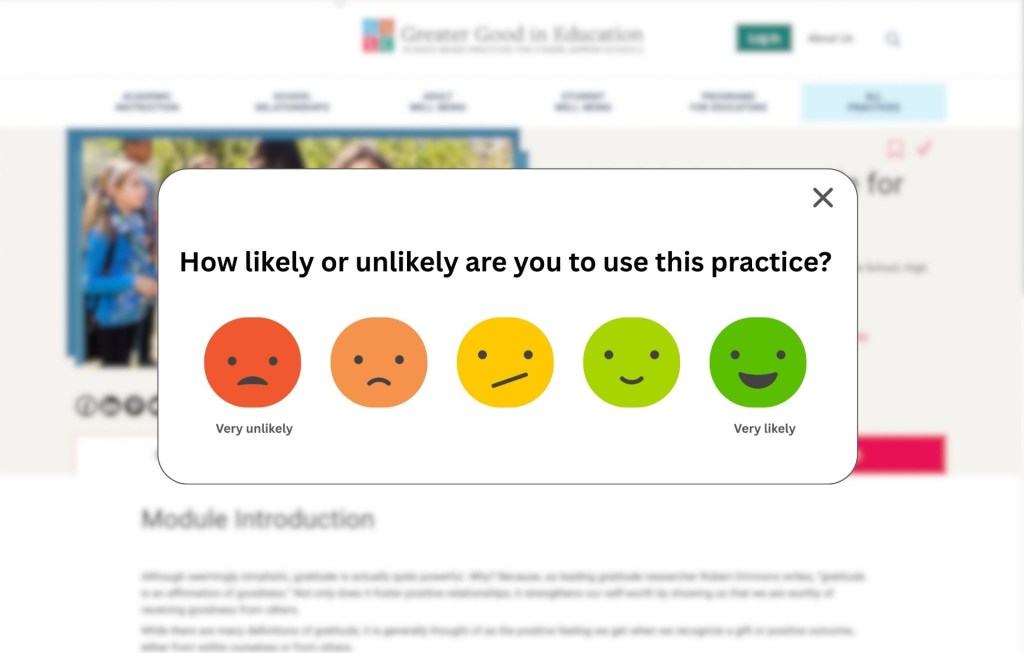
In a recent study published in Evidence & Policy, researchers Eldeeb, Ren, and Shapiro explored whether microsurveys could help fill this gap. Microsurveys are short surveys embedded directly on a webpage, triggered by specified interactions with the website. They can capture real-time feedback from users, providing actionable insights into whether research evidence is likely to be applied in practice.

Continue reading

Recognising the expertise of people with disability


Shane Clifton

This blog post is based on the Evidence & Policy article, Disability lived experience and expertise: recognising the expert contributions of people with disability’.

The disability rights movement was founded on the principle of ‘Nothing About Us Without Us’. This idea highlights the importance of including people with disability in decisions that affect them and recognises their expertise in shaping their own lives. While people with disability have too often been subject to controlling and dehumanising systems, as we explore in our recent study, there is now a growing understanding that disabled people should play key roles in designing, producing and leading disability healthcare, policy and research. The knowledge they bring is often called ‘lived experience’.

Continue reading

Beyond barriers: new insights from the ESRC Policy Fellowships


Matthew Flinders and Jessica Benson-Egglenton

This blog post is based on the Evidence & Policy article, ‘Understanding the dynamics of research–policy fellowships: an evaluative analysis of barriers and blockages’.

Supporting embedded academics requires understanding role types, managing ‘bandwidth,’ and setting clear expectations.

In recent years the dominant notion of ‘research excellence’ has expanded to include a joint emphasis on both knowledge creation and knowledge utilisation. Research funding is now targeted as addressing specific societal challenges. Forms of co-production and co-design have been promoted as a way of bringing potential research-users into project design and delivery. Thus, a vast and complex landscape of boundary-spanning initiatives and investments has been established to facilitate the use of research by policy-makers.

The challenge, however, is that policy-making is a messy and sometimes irrational process. Brian Hogwood and Lewis Gunn famously exposed this simple fact in their book Policy Analysis for the Realworld (1985), and recent work from the Institute for Government underlines the continuing validity of ‘the real-world messiness’ argument.

Continue reading

New Evidence & Policy issue – Volume 21: Issue 3

The editorial team of Evidence & Policy are excited to share this special collection of articles focused on the intersections between health, evidence use, and the application of research within evolving and complex public health policy contexts.

Articles in this issue explore and critically examine innovative models and frameworks (i.e., Functional Dialogue, Policy Advisory Boards) for leveraging research to inform policy in times of public health crisis (specifically, the COVID-19 pandemic). They also focus on improving medical practice (i.e., Knowledge Brokering, Contemporary Implementation of Traditional knowledge and Evidence (CITE) Framework, Integrated Systems of Care), as well as efforts to expand and broaden health care coverage and directly influence policy addressing structural determinants of health (Participatory Deliberative Processes).

Continue reading

Designing the CITE framework: integrating traditional knowledge in contemporary health


Amie Steel and Hope Foley

This blog post is based on the Evidence & Policy article, ‘Designing the Contemporary Implementation of Traditional knowledge and Evidence (CITE) framework to guide the application of traditional knowledge in contemporary health contexts: a Delphi study’.

The Contemporary Implementation of Traditional Knowledge and Evidence (CITE) framework is a groundbreaking guide designed to integrate traditional medicine (TM) with modern healthcare systems. Developed through expert consensus, with the results published in Evidence & Policy, this framework provides essential principles and criteria for evaluating and applying traditional knowledge in clinical practice, research, education and policy. As global health initiatives and institutions increasingly recognise the value of Traditional, Complementary and Integrative Healthcare (TCIH), the CITE Framework offers a timely, practical solution for ensuring the quality, safety, and efficacy of these practices in contemporary health contexts.

Continue reading

Are evidence-based policy and democratic equality reconcilable?


Tine Hindkjaer Madsen

This blog post is based on the Evidence & Policy article, ‘Reconciling science and democracy: evidence-based policy as seen from the perspective of a role-based democratic theory’.

For policy to be effective, it must be informed by reliable evidence, proponents of evidence-based policy argue. While this may be true, the evidence-based policy ideal nevertheless also conflicts with the requirements of democracy. This is because political equality is an essential element of democracy and evidence-based policy confers superior political influence on those who supply the evidence relative to ordinary citizens.

In my paper recently published in Evidence & Policy, I reflect on whether the evidence-based policy ideal is reconcilable with democratic equality after all. I first argue that evidence-based policy in fact also advances the value of political equality, because political equality requires that citizens be the choosers of political aims and utilising appropriate, high-quality evidence is the most reliable method of identifying how to achieve citizens’ aims. That is of course not to say that utilising appropriate, high-quality evidence will always lead to true beliefs about how to achieve a political aim, but it is the body of information we have that is most likely to be true and therefore utilising appropriate, high-quality evidence makes it more likely that citizens’ aims be realised. 

Continue reading

Big voter is watching you: how politicians evaluate expertise


Anina Hanimann

This blog post is based on the Evidence & Policy article, ‘How perceptions of voter control affect politicians’ evaluations of expertise in the news: a survey experiment on the role of accountability beliefs’.

The news serves as a crucial source of expertise for members of parliament (MPs), offering them cost-effective policy advice. However, the public nature of expertise in the news can significantly influence how MPs perceive and evaluate such expertise. Politicians who feel under intense scrutiny by their constituents may be more inclined to make decisions that align with public opinion, are easily justifiable, or simply appear to be the ‘right’ choice. These motivations can significantly shape the evaluation of expertise presented in the media.

My recent study in Evidence & Policy delves into this complex dynamic. I explore whether MPs’ assessments of expertise in news media differ depending on their perceptions of voter control. To investigate this, I analysed survey data from Swiss cantonal members of parliament, who were tasked with evaluating the credibility of expert statements.

Continue reading

Everybody can claim that a practice or policy is evidence-based. But when is it justified to do so?


Christian Gade

This blog post is based on the Evidence & Policy article, ‘When is it justified to claim that a practice or policy is evidence-based? Reflections on evidence and preferences’.

When you search the internet, you will find a myriad of claims about different practices or policies being evidence-based. To avoid ‘evidence-based’ becoming merely a buzzword that everyone can throw around and use whenever they deem it suitable, it is important to consider the conditions for when it is justified for you as an individual or organisation to claim that your practice or policy is evidence-based.

My argument is that this is the case if, and only if, three conditions are met – an argument that suggests that it depends on subjective preferences whether you are justified in claiming that your practice or policy is evidence-based, and that it is important to give more attention to the normative dimension of the field of evidence-based practice and policy.

Continue reading

How to do knowledge mobilisation? What we know, and what we don’t


Hannah Durrant, Rosie Havers, James Downe and Steve Martin

This blog post is based on the Evidence & Policy article, ‘Improving evidence use: a systematic scoping review of local models of knowledge mobilisation’.

Knowledge mobilisation (KM) describes a process for enabling the use of research evidence in policymaking and public service design and delivery. Approaches to KM have evolved over the last two decades – away from one-directional efforts to push research out to decision makers towards a kaleidoscope of research-policy-practice engagement across overlapping phases of knowledge production and policy action. These processes are generally poorly understood at local levels of decision-making, where the specificities of policy and public service context can undermine generic ‘what works’ claims.

Our recent Evidence & Policy article, ‘Improving evidence use: a systematic scoping review of local models of knowledge mobilisation’, identifies three key features of local KM as well as highlighting the gaps in our understanding of how KM is done and with what effect. 

Our aim was to determine how KM is done ‘on-the-ground’, which can get obscured in frameworks that emphasise complexity while simplifying process. We argue that more detail is needed on these practices of KM to inform and improve process. Equally, attention is also needed on demand for and impact of evidence on policy and practice decisions.

Continue reading