Local government has been unfairly characterised as a black hole when it comes to getting evidence into practice. While it is true that work remains to be done to cultivate interest in research across local government, our recent review found plenty of evidence of academia, local officials and other partners collaborating to make a difference around the generation and use of locally-meaningful research.
What seems to be less common, however, are coordinated approaches to organising research activity within and across an entire local government system. What can we learn from diverse approaches that harness mechanisms across different local government systems?
How do senior health service decision makers use evidence to inform their work and decision-making and what types of evidence do they use? What are the potential barriers and facilitators to research use by health service decision makers and are there ways to improve its usage?
We wanted to explore these questions in our qualitative study published in Evidence & Policy, which was conducted in Ireland’s national health service, the Health Service Executive (HSE). Our focus was on senior decision makers working in the organisation’s Healthcare Strategy, Clinical and Operations divisions, where evidence use has the potential to inform the quality and delivery of health services and workforce planning.
We conducted semi-structured interviews with 17 participants between August 2021 and January 2022.
For addressing grand societal challenges such as climate change or biodiversity loss, the power of research and innovation is an important consideration. In this context, a new framework has emerged that invites us to re-think how we can maximise the impact of research and innovation for societal challenges: ‘Transformative Innovation Policy’ or TIP. This framework emphasises the role of co-creation, learning and reflexivity as part of research, technology development and innovation processes.
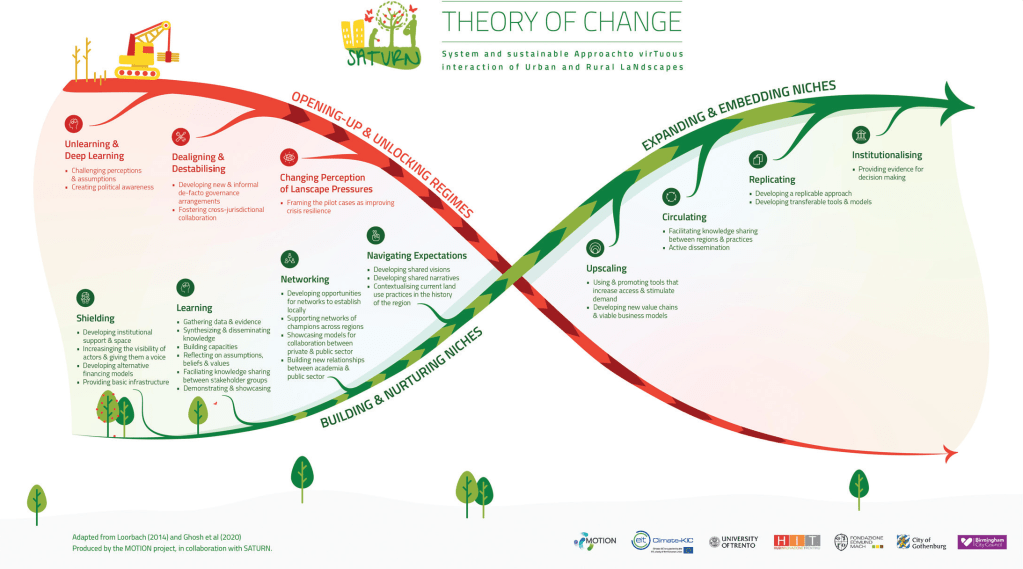
Our Evidence & Policy article, ‘Co-creation for Transformative Innovation Policy: an implementation case for projects structured as portfolio of knowledge services’, explores what co-creation means in practice for TIP, using the case of two innovation projects developed by the TIP consortium and EIT Climate-KIC, two international organisations seeking to promote innovation for global challenges. These projects were co-developed between experts on transformative innovation policy from the organisations previously mentioned, and scientific researchers and consultants grouped in two consortiums: one focused on sustainable mobility solutions (SuSMo) and the other focused on sustainable landscape management (SATURN). These projects have aimed at creating new knowledge that can be used by societal stakeholders in addressing specific sustainability problems and developing a ‘portfolio’ of knowledge services.
Kelsey Wuerstl, Miranda A. Cary, Katrina Plamondon, Davina Banner-Lukaris, Nelly Oelke, Kathryn M. Sibley, Kristy Baxter, Mathew Vis-Dunbar, Alison M. Hoens, Ursula Wick, Stefan Bigsby and Heather Gainforth
When reading articles describing a collaborative research decision, such as a research partnership creating a list of research priorities, we often read the statement, ‘The research partnership came to consensus’. But what does this statement actually mean – what is consensus, what does it mean to come to consensus, and how did the research partnership come to consensus?
Research partnerships are characterised by researchers and research users engaged in a collaborative research project to enhance the relevance and usefulness of research findings. Consensus methods require group members to develop and agree to support a solution that is in the group’s best interest. However, simply doing partnered research and using consensus methods does not guarantee the research addresses the priorities of those most affected, nor that inclusion and power dynamics have been considered. Consensus methods are often poorly reported and missing crucial information about how the research partnership made decisions about the project, as well as how issues of inclusion, equity and power dynamics were navigated.
We conducted a scoping review to better understand how research partnerships use consensus methods in health research and how these research partnerships navigate inclusion and power dynamics. Our findings, published in Evidence & Policy, identified six recommendations to enhance the quality of research teams’ consensus methods.
The use of evidence in public health decision-making is not as straightforward as it may seem – people have different ideas of what constitutes ‘evidence’, and how it should be interpreted and used in different contexts. Even when there is agreement on what constitutes evidence, research has shown that the same evidence, used in different contexts can lead to different policy decisions. A current example of this is e-cigarette policies and their recommendations. Our Evidence and Policy article explores how context, broadly defined as the factors that influence decision-making, influences the role of evidence in developing recommendations and how it may contribute to different policy approaches.
In a society that is steered by complex processes such as globalisation and institutional complexity, we are increasingly confronted with what is sometimes called ‘wicked problems’ (i.e., a problem that is difficult or impossible to solve because of incomplete, contradictory, and changing requirements that are often difficult to recognise). At Ghent University in Belgium, we were interested in trying to solve such problems by setting up a collaboration with diverse community stakeholders. We sent out a call to diverse stakeholders asking them to submit proposals on societal challenges that could be addressed by bringing together various actors and making use of scientific knowledge. An employee of the municipal department of well-being and equal opportunities submitted a case related to antisocial behavior by youth at a municipal park. The researchers involved selected the case as a pilot project to further investigate collaborative processes. For our study published in Evidence & Policy, we analysed a set of four video recorded co-creation sessions of this particular case to learn to better understand the process of how knowledge exchange can actually contribute to problem solving.
Our Evidence and Policy article reports the findings from a systematic review of how and for what purpose legislators use research evidence. It also examines legislators’ perspectives on enablers and barriers to using research evidence.
We searched for all published studies, either in English or French, in which the type of use and the barriers and facilitators to using research evidence by legislators were empirically examined. We included relevant studies regardless of the year of publication, the country where the study was conducted or the kind of legislatures. We found twenty-one studies, most of which were conducted in the United States. There has been a noticeable growth in studies since the 2010s.
We gain fascinating insights working alongside organisations across sectors in public services, that want to use data and evidence well to understand and track their impact. We specialise in working with organisations where it is hard to simply measure the difference they make, and where the main focus for change is relationships: work that educates, empowers, inspires, supports, encourages or influences people. What we have observed over the last 5 years, is that every organisation is influenced by their data culture, but it is rarely talked about. It is something we highlight in our new book: How do you know you are making a difference, from Policy Press.
Through our company Matter of Focus, we support organisations to understand the context for their work, set out their theories of change, and use this as a lens to collect and analyse data that can help them understand their change processes and evidence the difference they make. This means we host workshops and meetings where people really get to grips with different elements of their work, and we see what is inside the pandora’s box when organisations start to review the data they hold about their own work.
There are many ways in which researchers try to influence policy using the evidence that they produce. Studies have examined such research-policy engagement activities in public health, but little is known about what nursing and health sciences researchers do to promote the impact of their research in terms of policy. Our Evidence and Policy article explores nursing and health sciences researchers’ experiences of activities to promote their research and influence policy, across different career stages. It also explored researchers’ perspectives on barriers and enablers to maximising policy engagement.
We know that policymakers are most likely to use research evidence when the evidence fits what they need at that time, and that email is a cost-effective way of sharing such research. But researchers aren’t the only ones in legislators’ inboxes – constituents and special interest groups also seek out legislators’ attention and their inboxes. Thus, we need to understand how to better reach legislators with science so that we can cut through the noise and provide trustworthy research evidence at the right time. This is especially true during moments of crisis, such as the COVID-19 pandemic, when our study occurred, ‘Cutting through the noise during crisis by enhancing the relevance of research to policymakers’.
Although the literature theorises that policymakers use research they deem as timely and personally relevant, there has been a lack of practical strategies for improving perceived relevance. Through four experimental trials with US legislators across four issue areas (COVID-19, violence, exploitation and policing), we found support for one such strategy: including the legislators’ name or state/district name in the subject line. In three of the four trials, tailored emails were engaged with more often.









 Evidence & Policy Blog