Putting meat on the bones of data – how legislators define research evidence


Elizabeth Day

This blog post is based on the Evidence & Policy article, ‘How legislators define research evidence’.

When people ask about my research area, I answer that I study how policymakers use research evidence. Their response always follows a similar thread: ‘That sounds hard’ and ‘Ha! Do they even know what research is?’ These reactions align with a broader opinion in the United States that elected officials are clueless when it comes to using research evidence in the decision-making process.

Yet there are plenty of examples in research, legislation, and regulations where policymakers do use research in their work. My colleague Karen Bogenschneider and I wondered if this mismatch – assuming policymakers don’t use research when there are examples that they do – might have to do with a jingle-jangle problem: Do researchers and legislators actually mean the same thing when they say ‘research evidence’?

Continue reading

How to do knowledge mobilisation? What we know, and what we don’t


Hannah Durrant, Rosie Havers, James Downe and Steve Martin

This blog post is based on the Evidence & Policy article, ‘Improving evidence use: a systematic scoping review of local models of knowledge mobilisation’.

Knowledge mobilisation (KM) describes a process for enabling the use of research evidence in policymaking and public service design and delivery. Approaches to KM have evolved over the last two decades – away from one-directional efforts to push research out to decision makers towards a kaleidoscope of research-policy-practice engagement across overlapping phases of knowledge production and policy action. These processes are generally poorly understood at local levels of decision-making, where the specificities of policy and public service context can undermine generic ‘what works’ claims.

Our recent Evidence & Policy article, ‘Improving evidence use: a systematic scoping review of local models of knowledge mobilisation’, identifies three key features of local KM as well as highlighting the gaps in our understanding of how KM is done and with what effect. 

Our aim was to determine how KM is done ‘on-the-ground’, which can get obscured in frameworks that emphasise complexity while simplifying process. We argue that more detail is needed on these practices of KM to inform and improve process. Equally, attention is also needed on demand for and impact of evidence on policy and practice decisions.

Continue reading

Exploring evidence use in an Irish health service context


Susan Calnan

This blog post is based on the Evidence & Policy article, ‘Experiences and perceptions of evidence use among senior health service decision makers in Ireland: a qualitative study.’

How do senior health service decision makers use evidence to inform their work and decision-making and what types of evidence do they use? What are the potential barriers and facilitators to research use by health service decision makers and are there ways to improve its usage?

We wanted to explore these questions in our qualitative study published in Evidence & Policy, which was conducted in Ireland’s national health service, the Health Service Executive (HSE). Our focus was on senior decision makers working in the organisation’s Healthcare Strategy, Clinical and Operations divisions, where evidence use has the potential to inform the quality and delivery of health services and workforce planning.

We conducted semi-structured interviews with 17 participants between August 2021 and January 2022.

Continue reading

How to co-create in research and innovation for societal challenges

Carla Alvial Palavicino and Cristian Matti

This blog post is based on the Evidence & Policy article, ‘Co-creation for Transformative Innovation Policy: an implementation case for projects structured as portfolio of knowledge services’.

For addressing grand societal challenges such as climate change or biodiversity loss, the power of research and innovation is an important consideration. In this context, a new framework has emerged that invites us to re-think how we can maximise the impact of research and innovation for societal challenges: ‘Transformative Innovation Policy’ or TIP. This framework emphasises the role of co-creation, learning and reflexivity as part of research, technology development and innovation processes.

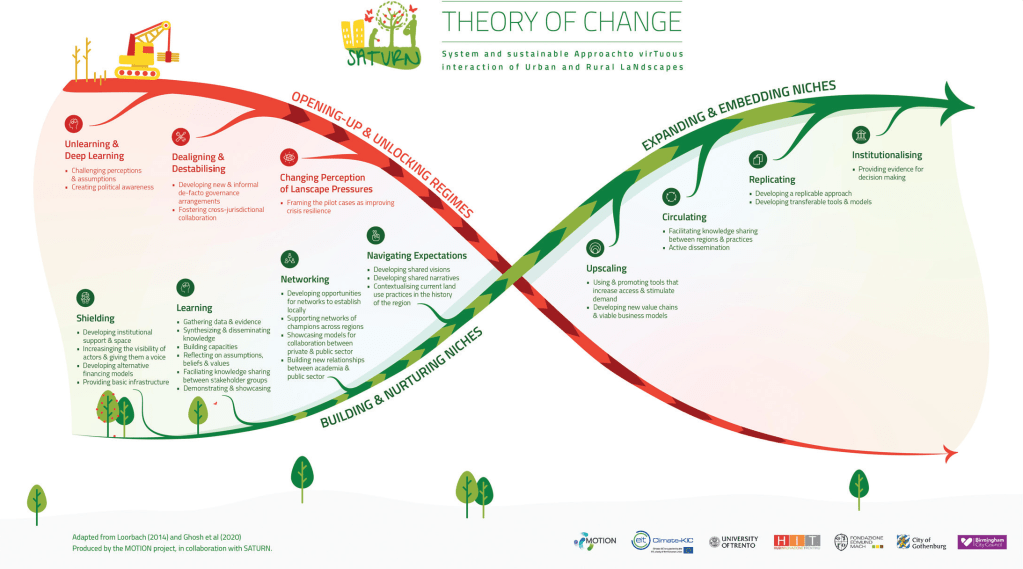
Our Evidence & Policy article, ‘Co-creation for Transformative Innovation Policy: an implementation case for projects structured as portfolio of knowledge services’, explores what co-creation means in practice for TIP, using the case of two innovation projects developed by the TIP consortium and EIT Climate-KIC, two international organisations seeking to promote innovation for global challenges. These projects were co-developed between experts on transformative innovation policy from the organisations previously mentioned, and scientific researchers and consultants grouped in two consortiums: one focused on sustainable mobility solutions (SuSMo) and the other focused on sustainable landscape management (SATURN). These projects have aimed at creating new knowledge that can be used by societal stakeholders in addressing specific sustainability problems and developing a ‘portfolio’ of knowledge services.

Continue reading

Considerations for conducting consensus in partnered research

Kelsey Wuerstl, Miranda A. Cary, Katrina Plamondon, Davina Banner-Lukaris, Nelly Oelke, Kathryn M. Sibley, Kristy Baxter, Mathew Vis-Dunbar, Alison M. Hoens, Ursula Wick, Stefan Bigsby and Heather Gainforth

This blog post is based on the Evidence & Policy article, ‘Building consensus in research partnerships: a scoping review of consensus methods’.

When reading articles describing a collaborative research decision, such as a research partnership creating a list of research priorities, we often read the statement, ‘The research partnership came to consensus’. But what does this statement actually mean – what is consensus, what does it mean to come to consensus, and how did the research partnership come to consensus?

Research partnerships are characterised by researchers and research users engaged in a collaborative research project to enhance the relevance and usefulness of research findings. Consensus methods require group members to develop and agree to support a solution that is in the group’s best interest. However, simply doing partnered research and using consensus methods does not guarantee the research addresses the priorities of those most affected, nor that inclusion and power dynamics have been considered. Consensus methods are often poorly reported and missing crucial information about how the research partnership made decisions about the project, as well as how issues of inclusion, equity and power dynamics were navigated.

We conducted a scoping review to better understand how research partnerships use consensus methods in health research and how these research partnerships navigate inclusion and power dynamics. Our findings, published in Evidence & Policy, identified six recommendations to enhance the quality of research teams’ consensus methods.

Continue reading

How do contextual factors influence the development of e-cigarette recommendations?

Marissa J. Smith, Srinivasa Vittal Katikireddi, Kathryn Skivington and Shona Hilton

This blog post is based on the Evidence & Policy article, ‘Contextual influences on the role of evidence in e-cigarette recommendations: a multi-method analysis of international and national jurisdictions’.

The use of evidence in public health decision-making is not as straightforward as it may seem – people have different ideas of what constitutes ‘evidence’, and how it should be interpreted and used in different contexts. Even when there is agreement on what constitutes evidence, research has shown that the same evidence, used in different contexts can lead to different policy decisions. A current example of this is e-cigarette policies and their recommendations. Our Evidence and Policy article explores how context, broadly defined as the factors that influence decision-making, influences the role of evidence in developing recommendations and how it may contribute to different policy approaches.

Continue reading

Building trust, managing expectations and overcoming organisational differences: how to solve complex problems through collaboration?

Alexis Dewaele

This blog post is based on the Evidence & Policy article, ‘A grounded theory on collaborative interactions in a community-university partnership: the case of youth in the public space’.

In a society that is steered by complex processes such as globalisation and institutional complexity, we are increasingly confronted with what is sometimes called ‘wicked problems’ (i.e., a problem that is difficult or impossible to solve because of incomplete, contradictory, and changing requirements that are often difficult to recognise). At Ghent University in Belgium, we were interested in trying to solve such problems by setting up a collaboration with diverse community stakeholders. We sent out a call to diverse stakeholders asking them to submit proposals on societal challenges that could be addressed by bringing together various actors and making use of scientific knowledge. An employee of the municipal department of well-being and equal opportunities submitted a case related to antisocial behavior by youth at a municipal park. The researchers involved selected the case as a pilot project to further investigate collaborative processes. For our study published in Evidence & Policy, we analysed a set of four video recorded co-creation sessions of this particular case to learn to better understand the process of how knowledge exchange can actually contribute to problem solving.

Continue reading

For what purposes is research evidence used in legislatures? What are the enablers and hindrances to using evidence in these settings?

Mathieu Ouimet

This blog post is based on the Evidence & Policy article, ‘Use of research evidence in legislatures: a systematic review’.

Our Evidence and Policy article reports the findings from a systematic review of how and for what purpose legislators use research evidence. It also examines legislators’ perspectives on enablers and barriers to using research evidence.

We searched for all published studies, either in English or French, in which the type of use and the barriers and facilitators to using research evidence by legislators were empirically examined. We included relevant studies regardless of the year of publication, the country where the study was conducted or the kind of legislatures. We found twenty-one studies, most of which were conducted in the United States. There has been a noticeable growth in studies since the 2010s.

Continue reading

The changing culture of evidence use in local government

Mandy Cheetham

This blog post is based on the Evidence & Policy article, What I really want is academics who want to partner and who care about the outcome’: findings from a mixed-methods study of evidence use in local government in England’.

Background

It is recognised that closer interaction between those working in policy and practice and academic researchers increases the likelihood of evidence being used to improve outcomes, but progress remains slow. Policymakers and researchers continue to be seen (unhelpfully) as occupying separate worlds, with limited research undertaken into efforts to address this perceived division.

In this blog post, we outline the main messages from a recently published article in Evidence & Policy, which draws on a collaborative, mixed methods study funded by the Health Foundation: Local Authority Champions of Research (LACoR). We explore evidence use in the context of local government from the perspectives of those who work there.

Continue reading

In the age of evidence-based decision-making, where can education decision makers really turn for evidence?

Fiona Hollands and Venita Holmes

This blog post is based on the Evidence & Policy article, Comparing evidence on the effectiveness of reading resources from expert ratings, practitioner judgements, and research repositories’.

In 20172018, a large school district in the U.S. was threatened by the state education agency with closure of 23 struggling elementary schools unless it could improve students’ performance on state-mandated assessments. The district’s Office of Elementary Curriculum and Development immediately tried to determine which reading resources (reading programmes, assessments, online tools, book collections, and professional development supports) were available at each school and to assess their effectiveness at improving student reading proficiency. To help with this evaluation task, our research-practice team explored various options for quickly providing suitable evidence on the effectiveness of each of 23 reading resources used at one or more of these schools. We expected to find reasonable consistency across multiple sources of information that we could use to help guide the district’s actions. The results were not quite as expected.

Continue reading