Examining evidence-integrated codesign as a program quality assurance strategy


Sarah Walker and Larry Norman

This blog post is based on the Evidence & Policy article, ‘Codesigning youth diversion programmes with community-led organisations: a case study’.

The equitable use of social science is a persistent governance challenge, particularly in applied social science and psychosocial treatment research. A common approach in applied social science is testing learning tools such as checklists, guides, manuals and trainings. These tools are developed to support behavior change at multiple levels and can be aimed at individuals, organisations or systems. To become evidence-based, these tools are tested against a control, ‘as usual’, or equivalent group. If effective in comparison, the package is then purveyed with the coveted ‘evidence-based’ moniker. Governments eager for tested approaches, as part of responsible governance, are then motivated to buy these tools and they are typically delivered by purveyor organisations as completed packages.

Some previous efforts focused on addressing both evidence-informed and community-engaged values have resorted to ‘list selection’ approaches in which community is involved in selecting a package from a pre-assembled list of programs. This approach engages community choice but limits the opportunity for community to contribute to more substantive design in the framing and content of these programs.

Continue reading

Evidence & Policy Call for Papers – Exploring the Role of Youth-led Research in Policy Change

Special Issue Editors: Mariah Kornbluh and Jennifer Renick

“It is a fundamental right of youth and young adults to participate in designing the programs and policies aiming to serve them.” (United Nations, 1989).

In recent years, there have been growing calls for the ‘democratization’ of research evidence, which argues for broadening the kinds of evidence that is considered legitimate in informing practice and policy (Doucet, 2019; Kirkland, 2019; Wegemer & Renick, 2021). Within youth-led participatory action research (YPAR), youth conduct systematic research and generate evidence to draw on to advocate for policy and/or programmatic changes (Kornbluh, 2023; Ozer et al., 2020). Such an approach aligns with the push for the democratization of evidence in broadening who are considered legitimate producers of knowledge (Fine & Torre, 2021; Ozer et al., 2020).

This special issue will explore the intersections between the use of research evidence to inform policy and YPAR, with the broad goals of studying and strengthening models for impact. In this special issue, we seek scholarship in theoretical frameworks, methodologies, presentations, and case studies that embrace YPAR as a vehicle for youth-led policy change. 

Submission for this issue might address the following topics:

  • Descriptive case studies of YPAR informing (or attempting to push for) policy change 
  • Theoretical models and approaches to YPAR-initiated policy change
  • An examination of the role of power and politics in relation to youth-led policy change
  • Examples of strategizing for scaling-up action from YPAR projects into policy change
  • Practices or procedures for addressing adultism and/or preparing adults to accept and implement youth-led policy change
  • Empirical explorations of the impact of YPAR-initiated policy change 

We imagine this special issue to function as a way to explore the research to practice gap within policy change, and whose perspectives are missing. Furthermore, we hope this issue will highlight ways in which policy makers can more critically accept or invite the voices of young people. 

Deadline: Interested authors should send a 300-word abstract to Special Issue Editors Dr Mariah Kornbluh at the University of Oregon (mkornbl2@uoregon.edu) and Dr Jennifer Renick at the University of Memphis (jrenick@memphis.edu) by 30 November 2024. Invitations for full paper submissions will be sent in mid-January, and full papers will be due by end of May 2025.

Evidence & Policy Call for Papers – Special Issue on Research (Mis)use and Mis/Disinformation in and around Education

Special Issue Editors: Joel Malin and Chris Lubienski

Mis- and dis-information are growing problems world-wide, corrupting trust and engagement in consumer markets, media, politics, and other institutions. This issue is particularly concerning for research-driven areas that involve public policy. Education is a prime area. Not only do education policymakers seek ‘research-based’ policy, but schools themselves, while subjected to false information campaigns, are also uniquely suited as institutions that have the capacity to counter misinformation by providing fact-based learning and critical thinking skills.

Continue reading

Evidence & Policy Call for Papers – Special Issue on Learning through Comparison

Special Issue Editors: Katherine Smith, Valerie Pattyn and Niklas Andersen

Evidence & Policy is pleased to invite abstracts for papers that explicitly employ comparative analysis and/or that develop insights about evidence use in policy through comparison. Authors of selected abstracts will be invited to submit a full paper for consideration for inclusion in a special issue that is aiming to demonstrate the conceptual and empirical contribution that comparative research can offer scholarship on evidence and policy.

Continue reading

Putting meat on the bones of data – how legislators define research evidence


Elizabeth Day

This blog post is based on the Evidence & Policy article, ‘How legislators define research evidence’.

When people ask about my research area, I answer that I study how policymakers use research evidence. Their response always follows a similar thread: ‘That sounds hard’ and ‘Ha! Do they even know what research is?’ These reactions align with a broader opinion in the United States that elected officials are clueless when it comes to using research evidence in the decision-making process.

Yet there are plenty of examples in research, legislation, and regulations where policymakers do use research in their work. My colleague Karen Bogenschneider and I wondered if this mismatch – assuming policymakers don’t use research when there are examples that they do – might have to do with a jingle-jangle problem: Do researchers and legislators actually mean the same thing when they say ‘research evidence’?

Continue reading

How to do knowledge mobilisation? What we know, and what we don’t


Hannah Durrant, Rosie Havers, James Downe and Steve Martin

This blog post is based on the Evidence & Policy article, ‘Improving evidence use: a systematic scoping review of local models of knowledge mobilisation’.

Knowledge mobilisation (KM) describes a process for enabling the use of research evidence in policymaking and public service design and delivery. Approaches to KM have evolved over the last two decades – away from one-directional efforts to push research out to decision makers towards a kaleidoscope of research-policy-practice engagement across overlapping phases of knowledge production and policy action. These processes are generally poorly understood at local levels of decision-making, where the specificities of policy and public service context can undermine generic ‘what works’ claims.

Our recent Evidence & Policy article, ‘Improving evidence use: a systematic scoping review of local models of knowledge mobilisation’, identifies three key features of local KM as well as highlighting the gaps in our understanding of how KM is done and with what effect. 

Our aim was to determine how KM is done ‘on-the-ground’, which can get obscured in frameworks that emphasise complexity while simplifying process. We argue that more detail is needed on these practices of KM to inform and improve process. Equally, attention is also needed on demand for and impact of evidence on policy and practice decisions.

Continue reading

We need a balanced approach to research ethics if we want our research to help everyone


Michael Sanders and Vanessa Hirneis

This blog post is based on the Evidence & Policy article, ‘Consent, assent and randomised evaluations.

The last decade or so have seen an explosion in the number of randomised controlled trials conducted in schools in the UK, and a similar, if less stratospheric, rise elsewhere in the world. The rise in the UK can be attributed in large part not to methodological interest by education academics, but the creation of the Education Endowment Foundation. Forming part of the UK Government’s “What Works” network aimed at improving evidence-informed decision-making in policy and overseeing a budget of more than £100 million, the EEF has funded hundreds of randomised trials of different interventions to boost children’s and young people’s attainment.

Enthusiasts of randomised trials argue that they provide the best and simplest (or least statistically burdensome) way of findings out which interventions work. However, opponents, often those responsible for designing and delivering interventions, consider them unethical because they necessitate withholding a potentially beneficial intervention from young people. In our paper, we consider another aspect of the ethics of randomised trials with young people – consent.

Informed consent is the cornerstone of postwar research, and aims to ensure that people are not experimented on against their will. As a principle, it is hard to argue with and should be at the centre of our thinking about how to run these kinds of trials.

Continue reading

Naturopaths place a stronger emphasis on the patient’s experience of their health compared to information from other health professionals when making clinical decisions


Prof Amie Steel, Dr Iva Lloyd, Prof Matthew Leach and Dr Vicky Ward

This blog post is based on the Evidence & Policy article, ‘Naturopaths’ behaviours, attitudes and perceptions towards the use of knowledge and information sources’.

The modern health landscape is dominated by the evidence-based practice paradigm which asks health professionals to prefer research evidence over other forms of knowledge and information when providing care to their patients. However, clinicians from most areas of health – including general practice and allied health – have argued that the realities of practice are not so simple. While this ‘messiness’ of clinical practice is documented for many mainstream health professions, there has been little to no research examining how clinicians from traditional medicine systems use knowledge and information in their practice, until now.

An international survey of naturopaths was recently published in Evidence and Policy which found they used a diverse range of knowledge and information sources when making clinical decisions. The survey respondents practice naturopathy, a traditional medicine system originating from Europe but now practiced in 108 countries across all world regions. Naturopathy uses a highly patient-centred and holistic clinical approach that prioritises preventive health and wellness, and patient education and empowerment.

Continue reading

Research by opioid manufacturers distorted authorship and overstated findings


Brian Gac, Hanna D. Yakubi and Dorie E. Apollonio

This blog post is based on the Evidence & Policy article, ‘Issues arising from the study design, conduct, and promotion of clinical trials funded by opioid manufacturers: a review of internal pharmaceutical industry documents’.

From 1999 to 2021, opioid overdoses caused over one million deaths in the US. The pharmaceutical industry has been held legally responsible in some cases for overstating the benefits and understating the risks of opioid use, leading to overprescribing that contributed to these deaths. Opioid manufacturers sponsor clinical trials to generate scientific evidence that supports use of their products to gain regulatory approval, and to use in commercial materials to promote drug sales. Previous research has found industry sponsored research may use dubious research practices to generate findings that justify use. Three examples of such research practices include inappropriate use of enriched enrollment trial design, ghost authorship, and overstatement of research findings.

In our recently published Evidence and Policy article, we identified research practices used in clinical trials funded by opioid manufacturers that created the perception that opioids were safe, non-addictive and effective in treating pain. Since 2005, confidential documents made public in litigation against pharmaceutical companies have been collected in the Opioid Industry Document Archive (OIDA) at the University of California San Francisco for storage in perpetuity. In January 2020, OIDA made available the first 503 documents that later become part of the larger OIDA, totaling over 62,000 pages, that were released as part of the Oklahoma litigation in a discrete collection named the Oklahoma Opioid Litigation Documents. These documents included clinical trial reports, witness declarations, internal corporate communications and marketing strategies regarding opioids, and served as the primary data source for the study.

Continue reading

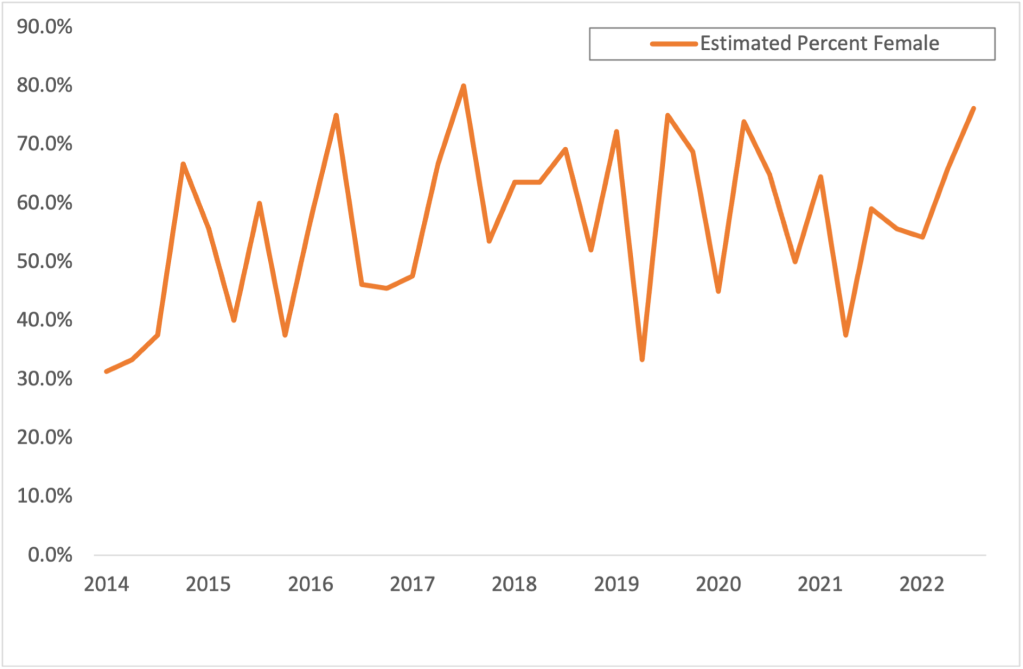
Are there gendered trends in research authorship at Evidence & Policy?


William L. Allen, Associate Editor

Gender differences in academic publications: why it matters

Across fields, there are concerns about the extent to which gender disparities exist in academic journal publications. Several studies of professional social science—including in economics, political science, and sociology—indicate women remain underrepresented in the pages of top journals. Inequalities in this regard may be particularly consequential because peer-reviewed publications remain one of the most important factors that contribute to success in applications for academic jobs, promotions, and grants.

While there are several reasons for this pattern, including authors’ perceptions of where their kinds of work are more likely to be favorably received, the simple fact of its presence has been enough motivation for some journal editorial teams to explicitly measure and report on the gender breakdown of both submissions and published work where possible.

Continue reading