Knowledge sharing in integrated care teams: why bringing people together isn’t enough


Vicky Ward

In this blog post Vicky Ward responds to questions from Co-Editor-in-Chief, Dan Mallinson about her recent publication, ‘Knowledge practices in integrated care: an examination of health and social care teams using collective knowledge creation theory’.

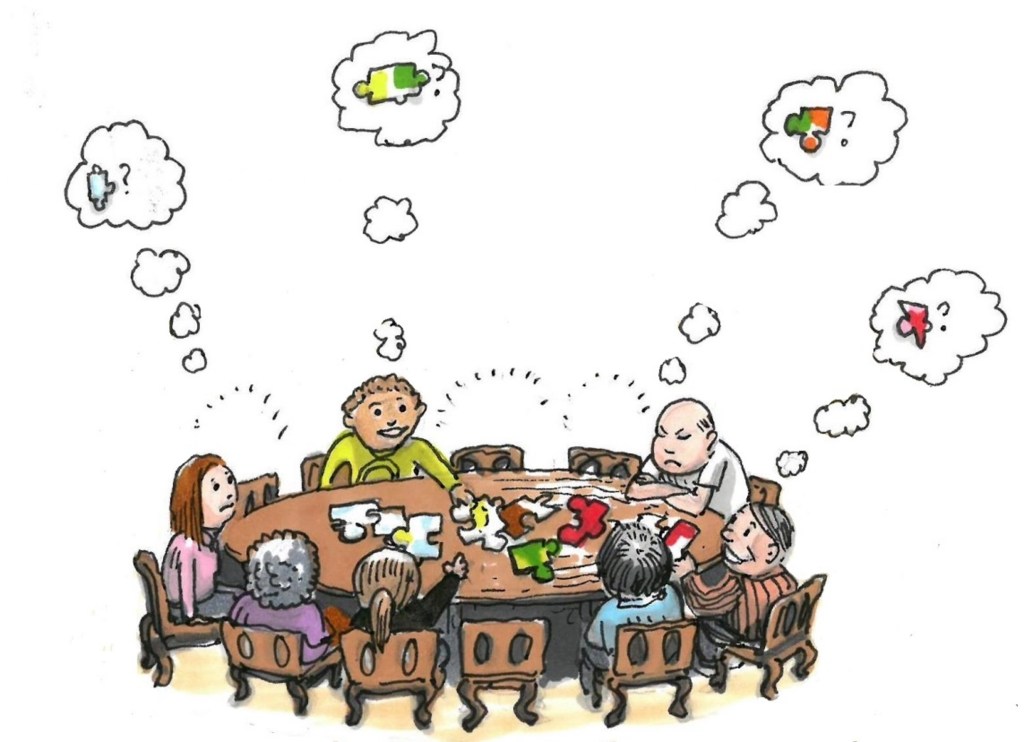
Integrated care is commonly seen as the means to bridge gaps between organisations, services and professions across the health and care landscape and improve care. The promise is compelling: bring health and social care practitioners together, and they’ll share their expertise to create holistic, joined-up care for people with complex needs. Simple, right?

Not quite. After spending over two years observing case management meetings across five integrated teams, I found that knowledge sharing was far messier than the policy rhetoric suggests. My research drew on organisational knowledge creation theory to reveal four patterns that help explain why this is the case.

Continue reading

Against unanimity: the perils of negotiating collective policy recommendations across a diverse third sector


Jane Cullingworth

This blog post is based on the Evidence & Policy article, Strengthening the role of third sector intermediary bodies in democratic governance: developing strategies with state and non-state actors’.

We can all agree that evidence needs to shape policy but how do we gather evidence, particularly from the frontlines? With the rise of participatory governance and an interest in the perspectives of communities, the third sector is uniquely placed to play a key role in facilitating and generating this evidence. But given the diversity of third sector stakeholders and multitude of perspectives, how is such evidence understood, interpreted and represented?

Animating knowledge requires intermediaries (known as knowledge brokers) to translate lived experience into action, addressing the know-do gap – that is, a gap between knowledge and policy. Across the third sector there are many intermediary bodies – organisations that support the sector and represent its interests. While these organisations are not typically thought of as knowledge brokers in the policy arena, they play an important role in ensuring that the voices of citizens and civil society groups are included in policy. Many are highly active in networks and partnerships with state actors.

Continue reading

What it really takes to mobilise knowledge: lessons from Danish street-level organisations


Dorte Caswell and Tanja Dall

This blog post is based on the Evidence & Policy article, ‘Structuring sustainable knowledge brokering in street-level organisations‘.

Let’s face it: everyone loves the idea of evidence-informed practice – until it’s time to actually do it. In our Evidence & Policy article, we dive into the messy, fascinating, and occasionally bureaucratically baffling world of knowledge mobilisation in public service organisations. Spoiler alert: there’s no magic wand, but there are some pretty good pointers on how to make the hard work of knowledge mobilisation work.

Our study  is based on a long-term collaboration with five Danish municipal employment services. These organisations juggle national policies, performance targets, and the unpredictable realities of human lives. Within this whirlwind, we asked: how can research and evidence become part of daily practice, rather than something that only shows up in PowerPoint presentations?

Continue reading

Which staffers are worth forming relationships with to further science?


Patrick O’Neill, Jessica Pugel, Elizabeth C. Long, D. Max Crowley and Taylor Scott

This blog post is based on the Evidence & Policy article, ‘Insight for knowledge brokers: factors predicting relationships with federal staffers’.

When it comes to furthering the reach of scientific evidence in policymaking processes, a large body of research has shown just how crucial personal relationships between researchers and policymakers can be. These personal relationships can help offset the overloading workload of policymakers and their staffers, especially considering they often rely on trusted sources for advice and information. However, there are often group norms, systemic differences, and other obstacles standing in the way of relationships between policymakers and researchers initially forming.

Continue reading

Exploring the lived experiences of university-based knowledge brokers and marginalised academics to better understand EDI within academic-policy engagement


Laura Bea and Alejandra Recio-Saucedo

This blog post is based on the Evidence & Policy article, ‘EDI in academic–policy engagement: lived experience of university based knowledge brokers and marginalised academics’.

Equity, Equality, Diversity and Inclusion (EDI)[1] in the world of Higher Education, public policy and everything in between has received increasing attention over the past few years especially. Within academic-policy engagement specifically, key actors have identified the need to diversify participation and knowledges (Morris et al, 2021; Hopkins et al, 2021; Walker et al, 2019). Additionally, Oliver et al (2022) reported that there is currently a ‘busy but rudderless mass of activity’ within knowledge mobilisation, and called for further practice that is informed by ‘existing evidence and theory’ (694). Notwithstanding the high level of activity, a gap in understanding what EDI in the context of academic-policy engagement really means still exists. Alongside this, there is a gap in understanding and knowing how EDI is understood and experienced by knowledge brokers, how university knowledge brokers drive it, and what strategies are being used to ensure EDI is embedded within academic-policy engagement activities (and what it even means to do this!).

Continue reading

The knowledge broker within: understanding evidence use inside public agencies


Louise Shaxson, Rick Hood, Annette Boaz and Brian Head

This blog post is based on the Evidence & Policy article, ‘Knowledge brokering inside the policy making process: an analysis of evidence use inside a UK government department’.

Knowledge brokering is often presented as a way of ensuring that evidence reaches government departments, but we have little understanding of what happens next. Our research shows that some civil servants can also act as internal knowledge brokers between evidence and policy. This raises important questions for how we understand processes of evidence-informed policymaking.

Continue reading

What can we learn from co-production approaches in voluntary sector evaluation work?


Louise Warwick-Booth, Ruth Cross and James Woodall

This blog post is based on the Evidence & Policy article, Obstacles to co-producing evaluation knowledge: power, control and voluntary sector dynamics’, part of the Special Issue: ‘Learning from Failures in Knowledge Exchange.

Co-production has been increasingly discussed as a positive and useful approach in health and social care research, based on principles such as partnership working, reciprocation, power sharing and the appreciation of all expertise. We have used co-production values to inform our evaluation work for many years, but in our Evidence & Policy article we reflect upon the challenges that such approaches bring, specifically in relation to sharing findings, known as knowledge exchange. Our article discusses evaluation work across three interventions that constitute perhaps the most challenging of our experiences in over a decade of such work. Conflict in evaluation work remains largely underreported, but we feel our experiences provide a useful contribution for readers.

Continue reading

Why failure isn’t the f-word in knowledge brokering


Stephen MacGregor

This blog post is based on the Evidence & Policy article, Theorising a spectrum of reasons for failure in knowledge brokering: a developmental evaluation’, part of the Special Issue: ‘Learning from Failures in Knowledge Exchange.

Failure often gets a bad rap, especially in professional settings. It’s usually seen as a waste of time and resources, something to steer clear of. But failure is not just an unfortunate outcome; it can be a crucial learning opportunity.

Particularly in higher education, the pressure is on for academics and universities to show the real-world impact of research. Here, knowledge brokers play a critical role: they are the human force behind efforts to connect research production and use contexts. Yet, the challenges and failures that these professionals face are not often discussed.

My recent Evidence & Policy article aimed to shed light on the spectrum of reasons for failure in the professional practice of knowledge brokering, drawing on a set of semi-structured interviews with a network of knowledge brokers. To understand knowledge brokers’ experiences, two frameworks were integrated: (a) the integrated Promoting Action on Research Implementation in Health Services (i-PARIHS) framework, and (b) Dr. Amy Edmondson’s Spectrum of Reasons for Failure framework.

Continue reading

Learning from failures in knowledge exchange: how hard can it be?


Peter van der Graaf, Ien van de Goor and Amanda Drake Purington

This blog post is based on the Evidence & Policy article, ‘Learning from failures in knowledge exchange and turning them into successes, which introduces the Special Issue: ‘Learning from Failures in Knowledge Exchange.

We don’t like talking about failures, as it signals loss of time, resources and reputation, but failures present opportunities for learning in knowledge exchange. However, this requires a ‘failure culture’ in academia and policy, in which failures are no longer avoided but actively encouraged. To learn how to turn failures into successes, we need to share and publish our failures, have early engagement with all stakeholders in the knowledge exchange process, and make more use of boundary spanners.

There are plenty of papers celebrating successes in knowledge exchange, but not many researchers and policy makers talk openly about their failures. However, learning from failures is just as important, if not more crucial, than celebrating successes. Allowing partners to reflect in a safe space on knowledge exchange practices and research projects gone wrong, in which communication broke down, partners did not engage or dropped out, and evidence was not taken up or ignored, will provide important lessons on how knowledge exchange practices and research can be improved.

At the 5th Fuse conference on knowledge exchange in public health, held in Newcastle, UK on 15-16 June 2022, we created such a space by bringing together over 100 academic researchers, policy makers, practitioners, and community members to share and reflect on thier failures and how to turn them into success. Our special issue brings together selected papers from the conference and papers that were submitted in response to an open call afterwards. From 23 original submissions from 14 different countries (including the UK, USA, Cananda, Norway, Switzerland, Kenya, Chile, South Korea, Canada and Portugal) and from a range of disciplines and areas of focus (Public Health, Primary Care, Oral Health, Sociology, Anthropology, Public Management, Policy-Making, and Community and Voluntary Sector), we invited four research papers and three practice papers for full submissions.

Continue reading

Knowledge brokers in local policy spaces: early career researchers and dynamic ideas

Sarah Weakley and David Waite

This blog post is based on the Evidence & Policy article, ‘Academic knowledge brokering in local policy spaces: negotiating and implementing dynamic idea types’.

It is now commonplace for many academics within higher education institutions to simultaneously take on the roles of both knowledge producers and knowledge brokers in policy spaces as part of their everyday working. In these roles at the intersection of the evidence and policy nexus, they undertake traditional research activities but also engage with policy actors using their research ideas and expertise to change conversations and develop solutions to policy problems. In our new article in Evidence and Policy, ‘Academic knowledge brokering in local policy spaces: negotiating and implementing dynamic idea types’, we reflect on how ideas move within local policy spaces and the hands that move them. We considered this issue in the context our own work with local bodies in two different policy arenas – one looking at social recovery after Covid-19 and one focussed on socioeconomic change.

Continue reading