Research by opioid manufacturers distorted authorship and overstated findings


Brian Gac, Hanna D. Yakubi and Dorie E. Apollonio

This blog post is based on the Evidence & Policy article, ‘Issues arising from the study design, conduct, and promotion of clinical trials funded by opioid manufacturers: a review of internal pharmaceutical industry documents’.

From 1999 to 2021, opioid overdoses caused over one million deaths in the US. The pharmaceutical industry has been held legally responsible in some cases for overstating the benefits and understating the risks of opioid use, leading to overprescribing that contributed to these deaths. Opioid manufacturers sponsor clinical trials to generate scientific evidence that supports use of their products to gain regulatory approval, and to use in commercial materials to promote drug sales. Previous research has found industry sponsored research may use dubious research practices to generate findings that justify use. Three examples of such research practices include inappropriate use of enriched enrollment trial design, ghost authorship, and overstatement of research findings.

In our recently published Evidence and Policy article, we identified research practices used in clinical trials funded by opioid manufacturers that created the perception that opioids were safe, non-addictive and effective in treating pain. Since 2005, confidential documents made public in litigation against pharmaceutical companies have been collected in the Opioid Industry Document Archive (OIDA) at the University of California San Francisco for storage in perpetuity. In January 2020, OIDA made available the first 503 documents that later become part of the larger OIDA, totaling over 62,000 pages, that were released as part of the Oklahoma litigation in a discrete collection named the Oklahoma Opioid Litigation Documents. These documents included clinical trial reports, witness declarations, internal corporate communications and marketing strategies regarding opioids, and served as the primary data source for the study.

Continue reading

The role of intermediaries in evidence-based policymaking: insights from the education system in Israel


Barak Ariel and Hagit Sabo-Brants

This blog post is based on the Evidence & Policy article, ‘Building bridges in place of barriers between school practitioners and researchers: on the role of embedded intermediaries in promoting evidence-based policy’.

The Israeli education system provides insights into the importance of intermediaries in evidence-based policymaking. Effective intermediaries can bridge the gap between research and practice by fostering collaboration and facilitating knowledge transfer between researchers, policymakers, and practitioners. The ideal intermediary should have the respect of both researchers and practitioners and a comprehensive understanding of both worlds. Practitioners should be involved in selecting and implementing intermediaries to meet their needs. Applying intermediaries in policymaking can result in more efficient and effective policies that benefit researchers and practitioners.

Continue reading

What does it mean to use research well?

Joanne Gleeson, Lucas Walsh, Mark Rickinson, Blake Cutler and Genevieve Hall

This blog post is based on the Evidence & Policy article, ‘Quality use of research evidence: practitioner perspectives’.

The use of research to inform practice can play a vital role in improving decision-making and social outcomes. As such, research use has gained widespread attention, with a range of initiatives now in place across sectors, countries and jurisdictions that promote it. Yet, what it takes for research to be used on the ground, let alone what quality research use looks like, is not well understood (Sheldrick et al., 2022). Without these understandings, there are real risks that research into research use will stay, as Tseng (2022) suggests, on ‘the proverbial shelf (or website) — far from the action of policy deliberations and decision-making’. This presents a challenge to the research community; to not only gain robust evidence on how research is used by practitioners, but also what it means to use research well and what it takes for it to improve.

In our new article in Evidence and Policy, we address this challenge by presenting findings from an investigation into Australian educators’ views on using research well in practice. Utilising thematic analysis, we draw on survey and interview data from almost 500 Australian educators (i.e., school leaders, teachers and support staff) to examine their perspectives in relation to a previously developed conceptual Quality Use of Research Evidence (QURE) Framework (Rickinson et al., 2020, 2022).

Continue reading

How to co-create in research and innovation for societal challenges

Carla Alvial Palavicino and Cristian Matti

This blog post is based on the Evidence & Policy article, ‘Co-creation for Transformative Innovation Policy: an implementation case for projects structured as portfolio of knowledge services’.

For addressing grand societal challenges such as climate change or biodiversity loss, the power of research and innovation is an important consideration. In this context, a new framework has emerged that invites us to re-think how we can maximise the impact of research and innovation for societal challenges: ‘Transformative Innovation Policy’ or TIP. This framework emphasises the role of co-creation, learning and reflexivity as part of research, technology development and innovation processes.

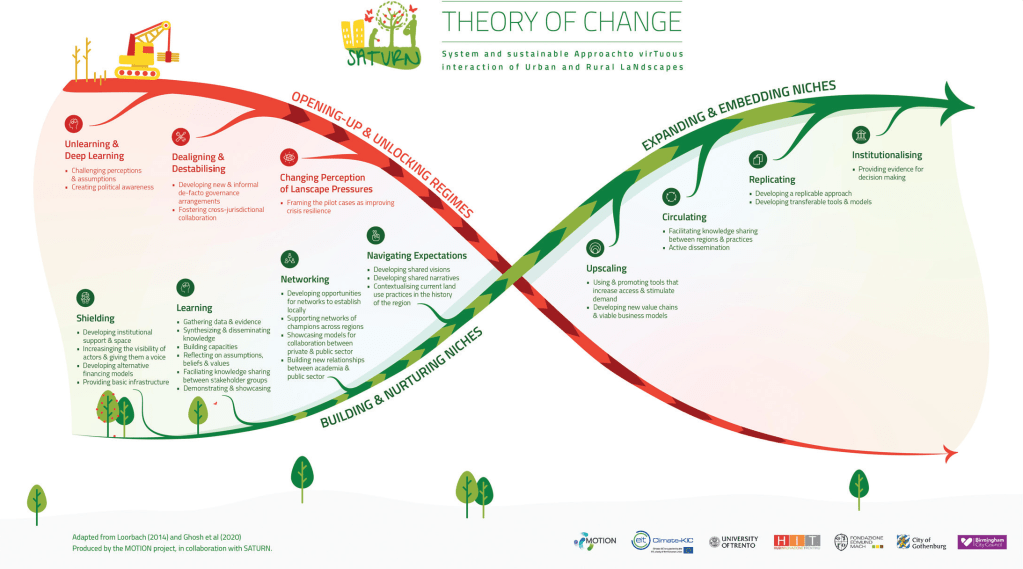
Our Evidence & Policy article, ‘Co-creation for Transformative Innovation Policy: an implementation case for projects structured as portfolio of knowledge services’, explores what co-creation means in practice for TIP, using the case of two innovation projects developed by the TIP consortium and EIT Climate-KIC, two international organisations seeking to promote innovation for global challenges. These projects were co-developed between experts on transformative innovation policy from the organisations previously mentioned, and scientific researchers and consultants grouped in two consortiums: one focused on sustainable mobility solutions (SuSMo) and the other focused on sustainable landscape management (SATURN). These projects have aimed at creating new knowledge that can be used by societal stakeholders in addressing specific sustainability problems and developing a ‘portfolio’ of knowledge services.

Continue reading

Building trust, managing expectations and overcoming organisational differences: how to solve complex problems through collaboration?

Alexis Dewaele

This blog post is based on the Evidence & Policy article, ‘A grounded theory on collaborative interactions in a community-university partnership: the case of youth in the public space’.

In a society that is steered by complex processes such as globalisation and institutional complexity, we are increasingly confronted with what is sometimes called ‘wicked problems’ (i.e., a problem that is difficult or impossible to solve because of incomplete, contradictory, and changing requirements that are often difficult to recognise). At Ghent University in Belgium, we were interested in trying to solve such problems by setting up a collaboration with diverse community stakeholders. We sent out a call to diverse stakeholders asking them to submit proposals on societal challenges that could be addressed by bringing together various actors and making use of scientific knowledge. An employee of the municipal department of well-being and equal opportunities submitted a case related to antisocial behavior by youth at a municipal park. The researchers involved selected the case as a pilot project to further investigate collaborative processes. For our study published in Evidence & Policy, we analysed a set of four video recorded co-creation sessions of this particular case to learn to better understand the process of how knowledge exchange can actually contribute to problem solving.

Continue reading

For what purposes is research evidence used in legislatures? What are the enablers and hindrances to using evidence in these settings?

Mathieu Ouimet

This blog post is based on the Evidence & Policy article, ‘Use of research evidence in legislatures: a systematic review’.

Our Evidence and Policy article reports the findings from a systematic review of how and for what purpose legislators use research evidence. It also examines legislators’ perspectives on enablers and barriers to using research evidence.

We searched for all published studies, either in English or French, in which the type of use and the barriers and facilitators to using research evidence by legislators were empirically examined. We included relevant studies regardless of the year of publication, the country where the study was conducted or the kind of legislatures. We found twenty-one studies, most of which were conducted in the United States. There has been a noticeable growth in studies since the 2010s.

Continue reading

How do you know if you are making a difference? Is your data culture getting in the way?

Sarah Morton and Ailsa Cook

We gain fascinating insights working alongside organisations across sectors in public services, that want to use data and evidence well to understand and track their impact. We specialise in working with organisations where it is hard to simply measure the difference they make, and where the main focus for change is relationships: work that educates, empowers, inspires, supports, encourages or influences people. What we have observed over the last 5 years, is that every organisation is influenced by their data culture, but it is rarely talked about. It is something we highlight in our new book: How do you know you are making a difference, from Policy Press.

Through our company Matter of Focus, we support organisations to understand the context for their work, set out their theories of change, and use this as a lens to collect and analyse data that can help them understand their change processes and evidence the difference they make. This means we host workshops and meetings where people really get to grips with different elements of their work, and we see what is inside the pandora’s box when organisations start to review the data they hold about their own work.

Continue reading

The long game: understanding and maximising researchers’ policy engagement activities across career levels

Alice Windle and Joanne Arciuli

This blog post is based on the Evidence & Policy article, ‘Research-policy engagement activities and research impact: nursing and health science researcher perspectives’.

There are many ways in which researchers try to influence policy using the evidence that they produce. Studies have examined such research-policy engagement activities in public health, but little is known about what nursing and health sciences researchers do to promote the impact of their research in terms of policy. Our Evidence and Policy article explores nursing and health sciences researchers’ experiences of activities to promote their research and influence policy, across different career stages. It also explored researchers’ perspectives on barriers and enablers to maximising policy engagement.

Continue reading

Entrepreneurship research makes a difference to policy, despite appearances to the contrary

Steve Johnson

This blog post is based on the Evidence & Policy article, ‘The policy impact of entrepreneurship research: challenging received wisdom’.

Conventional wisdom across the entrepreneurship research community is that policymakers take little notice of our research findings, preferring to follow the ideological inclinations and electoral ambitions of politicians and to take most notice of those who shout loudest. Policies are therefore not always evidence-based and as a result may not achieve their stated objectives.

This argument has some validity. There are many examples of research that questions the rationale for and impact of existing policies or makes policy recommendations that are subsequently rejected or ignored by policymakers. My recently published article in Evidence and Policy explores entrepreneurship research and policy in the UK over 30 years and finds that, despite appearances to the contrary, there are however grounds for optimism among those of us who believe that research can, does and should have some impact on policy.

Continue reading

Learning from 2020: Why collaboration and transdisciplinarity must mark our forward paths

Sara Bice and Martin Bortz

Today’s decision-makers need the evidence and insights of transdisciplinary research. Transdisciplinarity enriches our capacity to respond to complex problems by broadening perspectives on issues that are too complicated to be understood fully from one disciplinary angle.

COVID-19 presents an obvious example. The pandemic requires the insights and advice not only of medical and public health experts, but of policy scholars to inform government action; urban planners to model population movements and transport usage; epidemiologists to run big data models on potential virus spread; mental health experts on the implications of lockdowns and isolation; educationalists on the opportunities and pitfalls of home-schooling; behavioural psychologists on how to ensure restrictions will be accepted; the list goes on.

But how do we create diverse and effective research collaborations?

Continue reading