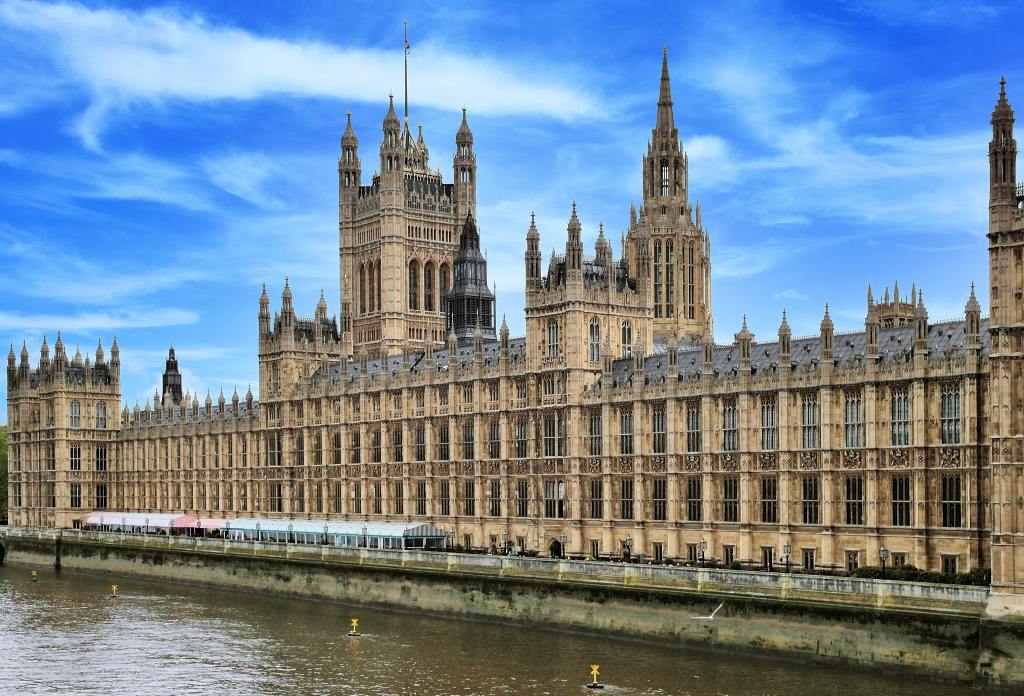
The UK Parliament performs key democratic functions holding the government to account by scrutinising policy, debating legislation and providing a venue for the public to air their views through elected representatives. Despite the key role of the UK Parliament in shaping government policy, for example in recent times on Brexit and COVID-19 (though many argue Parliament should have a greater role on the latter), scholars of science-policy interfaces have rarely explored how evidence is sourced and used in legislatures.
An evidence synthesis programme commissioned by the UK’s National Institute for Health Research from two academic teams produced a diverse range of outputs and methodological insights in its first three years of operation. The programme was subsequently re-commissioned for two further cycles. Scoping the topic and involving stakeholders were key to its success.
Matthew Johnson, Elliott Johnson, Laura Webber and Kate Pickett
The COVID-19 pandemic has increased interest in Universal Basic Income (UBI) as a means of addressing a range of socio-economic insecurities. While previous trials of cash transfer schemes have often focused on low-level transfers inadequate to satisfy the needs for which the policy was originally developed, emerging pilots are moving toward a position of increasing generosity. Our multidisciplinary project, Examining the Health Case for UBI, has brought together colleagues in behavioural science, public health, epidemiology and economics to establish pathways to health impact outlined in Figure 1 below. Our work suggests the potential for significant health impact and attendant economic benefit via reduced healthcare costs and increased economic activity. The model suggests that elements of impact may only be felt if payment is set at a more generous level. This could create greater return on investment and, ironically, a more cost-effective system.
We find that the adoption of evidence-based policies in US states is driven more by Machiavellianism than altruism. Although engagement with evidence-based policymaking (EBP) can produce more efficient and effective government, it can also supply new levers of control to politicians and bureaucrats, which can be used to produce electoral benefits. An appeal to EBP can be used to centralise control of executive functions, as well as to manipulate budgets, that incentivise adoption. Further, the construction, purpose and outcomes of these laws are influenced by the institutions, parties and officeholders who craft them. Our study finds that Democratic governors, Republican legislatures and state innovativeness are significant predictors of EBP adoption in the American states.
Especially in times of crisis, the relationship between evidence and policymaking may change dramatically. The current Covid-19 crisis generated manifestations of ‘evidence informed policymaking’ in an unprecedented way, both nationally and locally. It also showed that the need to use internationally organised, reliable data for effective policy interventions has never been more urgent in times of peace. This information needs to be both profound and directly available.
In the processes of shaping evidence informed policymaking, scientists from all kinds of disciplines play a crucial role to substantiate the development of policies. An international, virtual conference taking place 15–18 December 2020 will treat the outcomes of the current crisis as input for the challenge of professionalising the structured interaction between evidence and policymaking. The current learning processes will be analysed in the context of the existing knowledge infrastructure for policymakers. Instruments for creating evidence for policymakers have recently grown with the introduction of Big Data and the development of algorithms. Another widespread trend is the use of innovative evaluation processes in order to enhance the effectiveness of policy instruments and the growth of new standards for experimental policies.
‘Wouldn’t it be great if the evidence-to-policy work we’re seeing on the rise in Africa could be visible to a wider audience?’ That was the question my colleagues at the William and Flora Hewlett Foundation and I had on our minds in 2017, seeing the creativity and resourcefulness of a host of organisations and champions from the region as they advanced a complex agenda. Now, just a few years later, the opportunity to learn from African experiences is realised in the volume Using Evidence in Policy and Practice: Lessons from Africa, edited by Ian Goldman and Mine Pabari (Routledge, 2020). The book, which both articulates a conceptual framework for thinking about the elements of a contextually-determined evidence ecosystem and presents eight case studies about diverse experiences, adds immeasurably to the literature on evidence-informed decision making.
Are there lessons we can learn from the current response of service systems which have galvanized into action to meet the needs of children and families during the COVID-19 pandemic? How does the response of service systems affect our hypotheses about how change happens at scale?
In my professional role providing implementation support to public service systems, I’ve observed these systems responding to the COVID-19 pandemic with urgency and agility. The urgency is to be expected, but the agility has inspired me.
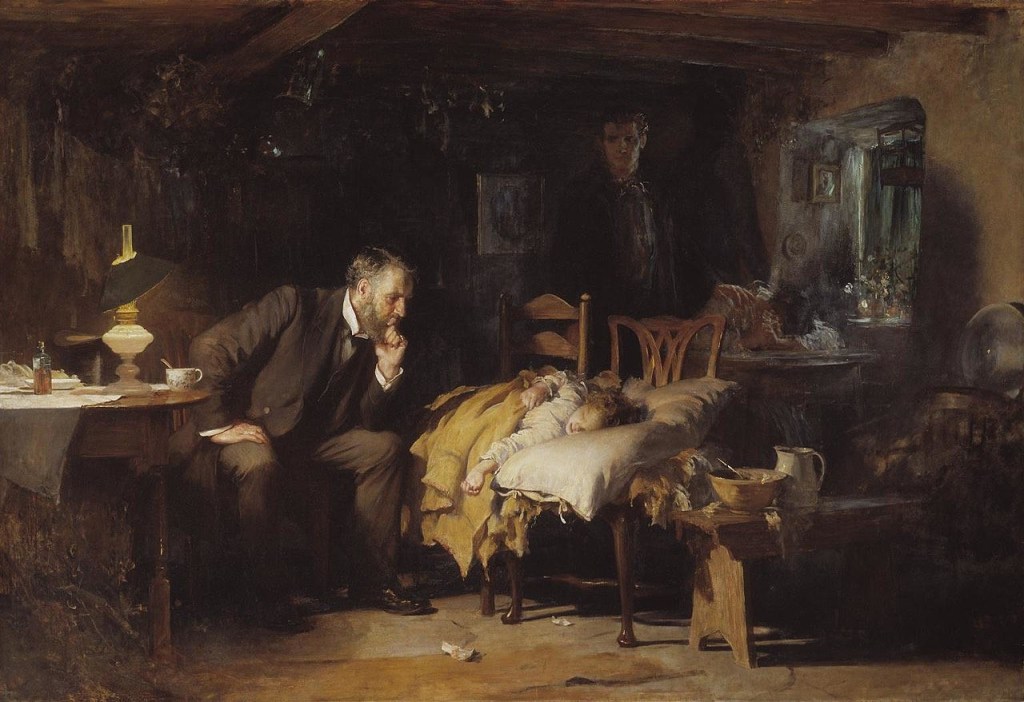
Recently I came upon this photo in a post in Twitter[1]. I have seen it before. It’s a powerful image by Sir Luke Fields. The child and doctor at the centre, in the glow of the lamp. The child ill and exhausted. The doctor earnestly observing. Watching. Sitting. Waiting. Thinking. Previously, and again this time, I absorb this painting as a statement on the medical profession. A reminder of the solemness of their work. The gravity of life and death. The role of the family in the background, secondary and in the dark.
But then I was challenged to really look at the image. The Dad wasn’t simply in the background, he was standing in the shadows, he was stoic, he was purposefully and intently studying the doctor for signals. Only after considerable prodding, did I notice Dad’s hand comforting his distraught wife. The Mum collapsed in prayer, or distress, or both. Dad’s hand gently on her shoulder, reassuring her, or maybe channelling his energy into her prayer. Her faith. Their hope.
The COVID-19 pandemic is shining a light on the roles that evidence and expertise can play in policy and practice. Understanding the nature of these debates, and developing tools to help decision-makers navigate them, is the focus of the Evidence & Policy community. In this post, we consider how our reflections on the field’s key insights help us understand the role evidence is playing in the UK’s response to the current pandemic:







 Evidence & Policy Blog