Designing futures together: co-designing health and social services with structurally vulnerable populations

Samantha K. Micsinszki, Alexis Buettgen, Gillian Mulvale, Sandra Moll, Michelle Wyndham-West, Emma Bruce, Karlie Rogerson, Louise Murray-Leung, Robert Fleisig, Sean Park and Michelle Phoenix

This blog post is based on the Evidence & Policy article, ‘Creative processes in co-designing a co-design hub: towards system change in health and social services in collaboration with structurally vulnerable populations’, part of the Special Issue on Creativity and Co-production.

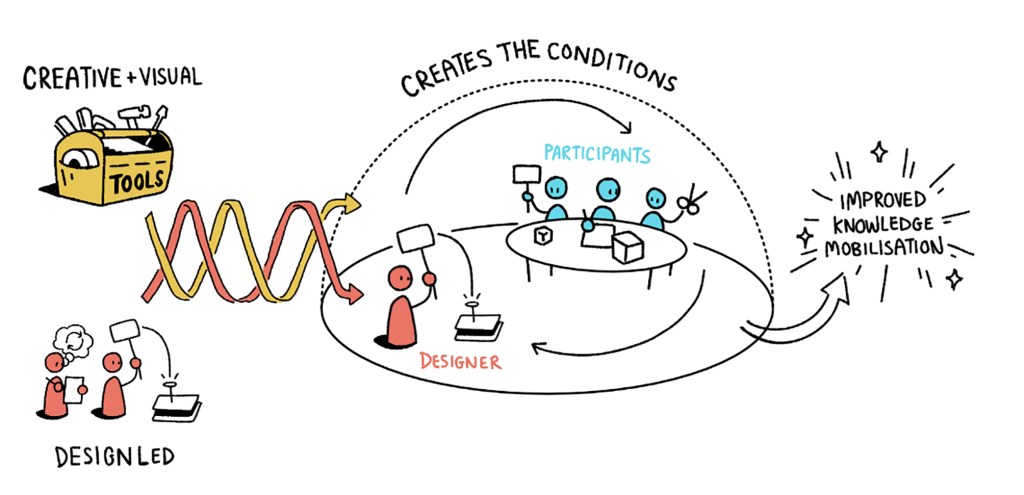
What creative tools can we use to disrupt the status quo and create truly inclusive health and social services? Co-designing evidence and policy change in collaboration with health and social service users and their families is part of an exciting and growing international movement. In our Evidence & Policy article, ‘Creative processes in co-designing a co-design hub: towards system change in health and social services in collaboration with structurally vulnerable populations’, we highlight how our interdisciplinary team of researchers, trainees and lived experience experts engaged in a three-year collaborative process to promote engagement, education, and innovation in equity-based co-design. This article is part of a special issue on creativity and co-production that highlights how collaborative practices, such as co-design and co-production, can be elevated using creative devices and tools (e.g., imagination, storytelling, art etc.) to create a shared language, build relationships, and make meaning.

Co-design approaches take a person-centered perspective, utilizing a design lens to develop solutions to problems in collaboration with lived experience experts. This approach can redistribute power when we meaningfully and effectively engage individuals and communities who experience structural vulnerabilities that affect their health and well-being (e.g., racism, sexism, ableism, colonialism). In other words, how do we ensure that diverse experiences are included and that co-design processes lead to lasting system change?

Continue reading


Can creative co-design improve healthcare intervention development?

Richard Webber

This blog post is based on the Evidence & Policy article, ‘The creative co-design of low back pain education resources’, part of the Special Issue on Creativity and Co-production.

In our recent Evidence and Policy article we provide a detailed description of how a specific creative co-design approach was used to blend academic knowledge with stakeholder knowledge in the development of a complex intervention that addressed a NICE guideline recommendation about information and advice for people with back pain.

In the UK, the National Institute of Clinical Excellence (NICE) produce clinical guidelines based on the best research available in order ensure people receive consistent evidence-based care. However, despite almost universal agreement amongst health professionals that clinical practice should be based on best available evidence, guidelines are routinely not used as specified in decisions relating to individual care.

Continue reading

Enacting change: using Forum Theatre to improve post-injury psychological care

Kate Beckett and Toity Deave

This blog post is based on the Evidence & Policy article, ‘Using Forum Theatre to mobilise knowledge and improve NHS care: The Enhancing Post-injury psychological Intervention and Care (EPPIC) study’, part of the Special Issue on Creativity and Co-production.

We know that physical trauma causes psychological problems. The evidence suggests that around 30% of injured adults will develop a psychological problem such as Post Traumatic Stress Disorder within twelve months of injury and these have a significant impact on their recovery. Despite this, NHS management of trauma patients’ psychological needs is generally poor, which leads to under-recognition, delayed treatment, and increased individual, societal and healthcare costs.

The inability of this evidence to directly influence practice is symptomatic of a broader concern about the generation and uptake of research. It goes to the heart of how we perceive human health and healthcare (and the interplay between physical, social, and psychological factors), how we produce knowledge to shape and change it, and how we understand the way knowledge is effectively transmitted in practice. Our study, as published in a recent Special Issue of Evidence & Policy, used innovative methods to address these wider challenges and improve post-injury psychological care.

Continue reading

Improving knowledge mobilisation in healthcare: a qualitative exploration of creative co-design methods

Dan Wolstenholme

This blog post is based on the Evidence & Policy article, ‘Improving knowledge mobilisation in healthcare: a qualitative exploration of creative co-design methods’, part of the Special Issue on Creativity and Co-production.

Creative methods help get evidence and policy into practice

Evaluating 14 healthcare improvement and research projects that used creative methods, we identified three interconnected themes that result in the optimal conditions for getting evidence into practice.

Co-production, co-creation and co-design are increasingly used in healthcare research knowledge mobilisation. These methods have grown in popularity, and the broad range of approaches are often used uncritically. Our recently published Evidence & Policy paper focuses on the creativity component of these approaches, specifically when working with design professionals.

Continue reading

Four questions relating to creativity and co-production

Joe Langley, Nicola Kayes, Ian Gwilt, Erna Snelgrove-Clarke, Sarah Smith and Claire Craig

Reflections arising from an Evidence & Policy Special Issue exploring the role and value of Creative Practices in Co-production. This blog post is based on the Editorial to the Special Issue, ‘Exploring the value and role of creative practices in research co-production’.

Our Evidence & Policy Special Issue, exploring the value and role of creativity and co-production in research, highlights four key questions:

  1. What constitutes research? And who decides?
  2. What constitutes legitimate knowledge?
  3. What constitutes creativity and co-production in research?
  4. To what extent are we constrained in the opportunities to undertake ‘creative’ research?
Continue reading

Knowledge Brokerage: The Musical

Megan Auld, Emmah Doig and Sally Bennett

This blog post is based on the Evidence & Policy article, ‘Knowledge Brokerage: The Musical: an analogy for explaining the role of knowledge brokers in a university setting’.

It would be an untruth to say that we knew exactly what we were doing when we started our role as knowledge brokers. As experienced clinicians and researchers we’d lived on both sides of the knowledge-action coin, and we’d certainly had a few good tries at making them come together. The literature told us we were ‘capacity builders’, ‘knowledge managers’, ‘boundary spanners’ who required a myriad of personal characteristics to pull this thing off (only some of which, to be honest, I thought I actually possessed). Here began a journey to make the theoretical come to reality and after living and breathing knowledge brokerage in a university setting for a year, we wanted to make sure that the experiences we had would span the boundaries of knowledge for other would-be brokers.

In an exploratory study, as two knowledge brokers we recorded our activities within a school of health in a large university setting using the Expert Recommendations for Implementation Change (ERIC) categories over a period of nine months and reported the results in our recently published Evidence & Policy practice paper. We wanted to make sure that we helped knowledge brokers know what the job consisted of when they showed up to work on a Monday morning. Thus, the birth of Knowledge Brokerage: The Musical – an analogy to help explain the role of knowledge brokers in higher education.

Continue reading

Guidelines for healthcare about promotion of healthy lifestyle habits – what knowledge should they be based on?

Helena Lagerlöf, Teun Zuiderent-Jerak and Morten Sager

This blog post is based on the Evidence & Policy article ‘Epistemological deliberation: the challenges of producing evidence-based guidelines on lifestyle habits

Drafting recommendations is an art that requires more attention to the choices between different views of knowledge, formats and standards and their ramifications.

Continue reading

Stateless nomads, with little to trade (or how knowledge brokers are set up to fail and how to avoid this)

This blog post is based on the Evidence & Policy article, ‘Understanding knowledge brokerage and its transformative potential: a Bourdieusian perspective‘.

Graham Martin, Sarah Chew and Natalie Armstrong

Some problems in society result from institutions’ traditional tendency to work in isolation from one another. An example is the slothful pace at which evidence from healthcare research reaches practice:  some estimates suggest it can typically take as long as seventeen years. Increasing collaboration between institutions is the obvious remedy, but ‘If you think competition is hard, you should try collaboration’.

The institutional fields of research and practice have very different structures and value systems. This means that getting them to collaborate requires some external impetus. Recently, knowledge (brokering a range of activities designed to link the producers and users of knowledge by, for example, encouraging new relationships, devising new ways of working together, and helping to move knowledge across boundaries) has been promoted as a way of enabling collaboration and even bringing about changes in the working relationships of institutions. Knowledge brokerage has become a role in its own right, but its popularity as a remedy outstrips evidence for its efficacy.

Continue reading

Decision-making of knowledge brokers in moving evidence to action along pathways in global health

Theresa Canova Norton

‘An e-mail never made me change the way I do things’, a colleague once said. Implicit in this statement is the idea that passively receiving information alone is unlikely to motivate change. How might this observation inform the way we approach disseminating the best available evidence? This is what we explore in our Evidence & Policy article, ‘Maybe we can turn the tide’: an explanatory mixed-methods study to understand how knowledge brokers mobilise health evidence in low- and middle-income countries’.

Knowledge brokers are intermediaries who provide a potentially vital role galvanising change. Studies of knowledge brokers have mostly taken place in high-income countries, so we know much less about knowledge brokers in LMICs. To help address this gap, a global health focused research team conducted three studies following up with knowledge broker participants of international conferences in 2012, 2013 and 2015. The aim was to identify whether evidence from the conferences was shared with others and led to actions such as changes in health policy and practice, and what factors influenced decisions to share and act on evidence.

Continue reading

Four practical steps to increase knowledge exchange between researchers and policymakers

Peter van der Graaf

Keen to have impact with your research but getting lost in all the knowledge exchange frameworks and models that are out there? Based on ten years’ experience working in translational public health for Fuse – The Centre for Translational Research in Public Health, a UK Clinical Research Centre collaboration across five universities in North East England, we identified four practical steps to develop collaborative research and achieve meaningful change in policy and practice.

The challenges of using research to inform policy and practice are well documented, including in public health where the evidence base for interventions or programmes is patchy or contested. In response to these challenges, an abundance of models and frameworks have been developed in recent years that try to define the knowledge exchange process (how research evidence can be used, in combination with other types of knowledge, to change policy and practice). Practitioners and researchers venturing into the field of knowledge exchange are bewildered by the options available, which don’t go beyond the conceptual level and fail to describe in practical terms what research translation on the ground looks like.

Continue reading